

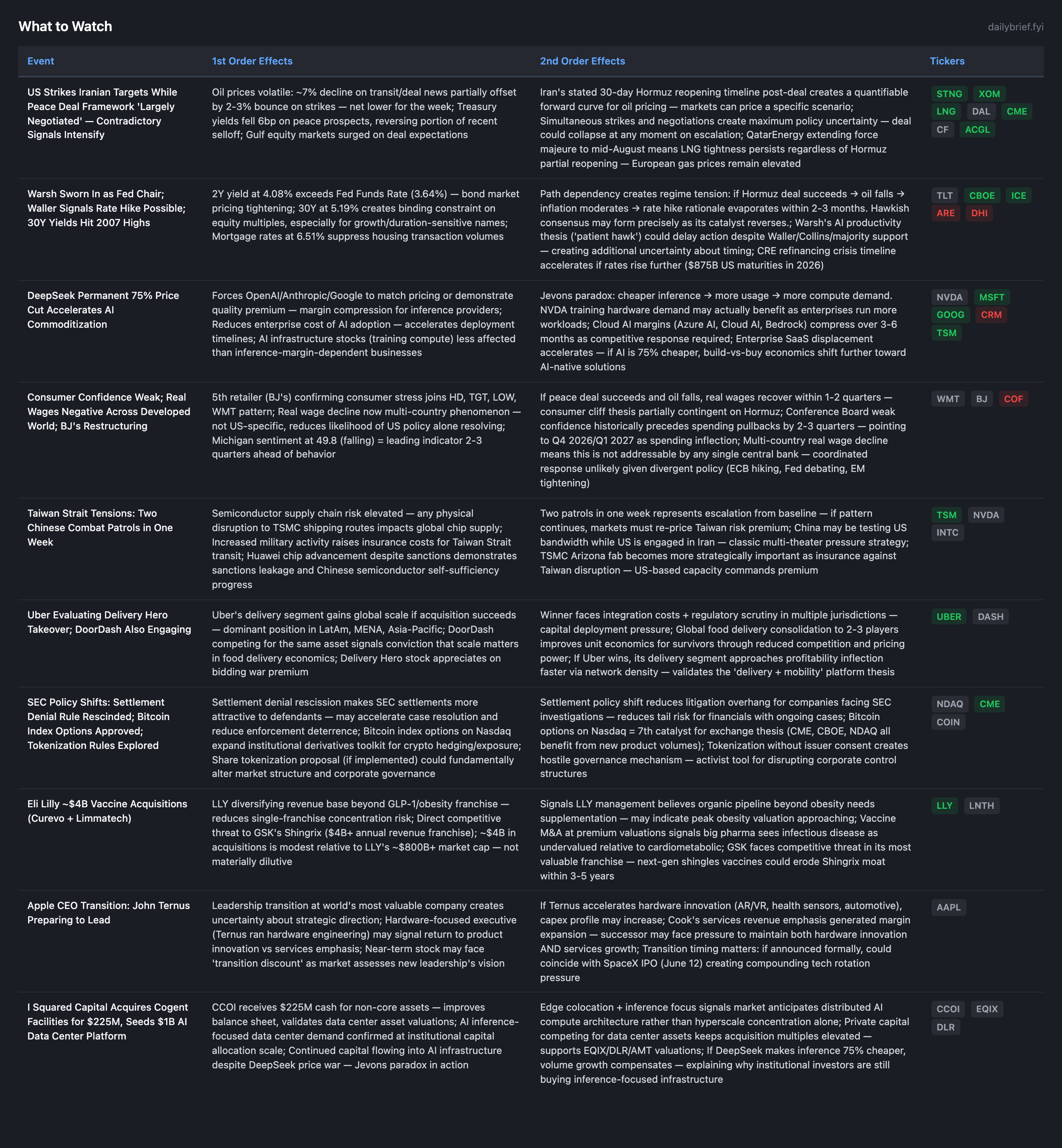
Since the May 25 brief, the Hormuz situation has entered its most contradictory phase: US military strikes on Iranian missile sites and naval vessels occurred simultaneously with Trump claiming the deal framework is “largely negotiated.” Markets have chosen to weight the deal narrative over the strikes, with Dow +300, oil net lower, and Treasury yields falling 6bp. The market is expressing a view that strikes are a negotiating tool rather than an escalation signal.
The 72-hour confirmation window identified in the prior brief (expires ~May 28) remains the critical decision point. The new data point today: Iran explicitly stating it would reopen Hormuz within 30 days of a peace deal (Nikkei via Reuters Tier 1). Combined with prior LNG transit and deal framework reporting, this adds a 7th concurrent de-escalation indicator. However, US strikes on the same day introduce a credible reversal mechanism — the pattern could break either way within hours.
The second critical development: real wages are now confirmed negative across the developed world (US, UK, other DMs), per FT. Multi-country synchronization means this consumer weakness signal is harder to resolve via any single policy lever.
New Developments
US Strikes + Deal Negotiations = Maximum Ambiguity
The most novel aspect of today’s events is the explicit co-existence of military escalation and deal finalization. Kinetic strikes demonstrate capability while simultaneously offering diplomatic off-ramps. Markets identifying this as coercive diplomacy rather than war escalation explains the positive equity reaction.
Iran’s specific statement that Hormuz reopens “30 days after a peace deal” is new and quantifiable. Prior signals were vague (”Hormuz completely open” without timeline, “deal largely negotiated” without mechanism). A 30-day timeline allows the oil futures curve to price a specific scenario — which it appears to be doing with near-month contracts declining more than deferred.
Key implication: If the deal closes within the next 1-2 weeks, Hormuz reopens by early July. This timeline coincides with the IEA’s “red zone by July” inventory warning — creating a potential collision between “demand seasonally peaks” and “supply partially restored.” The net effect on oil depends on which force dominates.
QatarEnergy’s force majeure extension to mid-August is the counter-signal markets are under-weighting. Even if Hormuz technically reopens, QatarEnergy’s contractual position means European LNG buyers remain short supply through summer. The physical market tightness doesn’t resolve instantly with a political agreement — Jeff Currie’s “tank bottoms in Asia” thesis applies regardless of transit status for 2-3 months post-reopening.
Global Real Wage Compression: Structural
The FT confirming real wages negative across US, UK, and other developed economies carries different implications than “US CPI exceeds US wage growth.” Multi-country synchronization means: (1) no single central bank can solve it, (2) competitive devaluation becomes tempting, (3) consumer spending weakness is coordinated globally rather than offsetting across regions.
ECB’s Schnabel explicitly stating hikes proceed regardless of Iran deal underscores this: European policymakers view inflation as embedded beyond energy. If the ECB hikes in June while the Fed debates and BOJ continues easing, currency dislocations accelerate — strengthening the dollar, weakening EM currencies, and creating feedback into the EM crisis pathway.
Sri Lanka’s surprise 100bp hike is the clearest manifestation of EM forced tightening. Any oil-importing EM with currency pressure (India, Turkey, Indonesia, Bangladesh) faces the same choice between rate hikes (crushing domestic demand) or currency depreciation (importing more inflation).
Taiwan Strait: Two Combat Patrols in One Week Above Baseline Cadence
Two Chinese military “combat patrols” near Taiwan in a single week is above the recent baseline cadence. This may be opportunistic — testing US bandwidth while Washington is occupied with Iran — or it may represent a genuine escalation in China’s pressure campaign.
The investment implication is asymmetric: if nothing happens (most likely), this is noise. If it escalates further, semiconductor supply chains face existential disruption that dwarfs Hormuz in economic impact. TSMC ships ~90% of the world’s advanced logic chips through Taiwan Strait-adjacent routes. This tail risk deserves higher monitoring priority than it’s currently receiving.
I Squared Capital $1B AI Data Center Platform: Jevons Paradox in Action
The timing of a $1B institutional data center investment focused on AI inference, occurring the same week DeepSeek cuts inference prices 75%, is the Jevons paradox operating in real-time. Cheaper inference → more demand → more infrastructure needed. Institutional capital is betting that volume growth overwhelms unit price decline, which is the correct framework for infrastructure owners (they care about utilization rates, not per-query pricing).
What to Watch
Developing Themes
Hormuz 72-Hour Window: Day 2 of 3
Simultaneous strikes + deal progression + Iran’s 30-day timeline + QatarEnergy force majeure extension = contradictory signals. The net direction is slightly more positive than yesterday (Iran providing specific timeline), but strikes introduce reversal risk. No position changes warranted until the window closes.
Rate Hike Consensus: Warsh Now Operational
Warsh is now sworn in and faces his first FOMC (June 16-17). The committee he inherits has documented majority support for hikes. Waller’s explicit “next move could be a hike” statement as a Governor (always votes) carries more weight than regional president commentary. The 2Y at 4.08% vs Fed Funds at 3.64% = bond market has priced a hike before the Fed has acted. If Hormuz deal succeeds and oil falls materially, the committee faces a dilemma: act on documented consensus formed during high-oil conditions, or wait for data to reflect lower oil?
AI Momentum at Record Levels; Morningstar Says Largest Discount Since 2019
Bloomberg confirms AI-driven momentum stocks at record performance streak. Morningstar simultaneously finds AI-theme stocks at largest discount since 2019. These are not contradictory — momentum measures price trajectory while “discount” measures valuation relative to fair value estimates. Both can coexist if AI companies grow into their valuations via earnings while stock prices track laterally. Record momentum streaks historically precede corrections, but timing is impossible to identify.
SpaceX IPO Confirmed for Nasdaq (SPCX)
No new data today beyond confirmation of Nasdaq listing. Pentagon-SpaceX pricing dispute over Starlink during Iran conflict adds a new dimension: SpaceX’s government revenue stream faces political/contractual risk even as commercial revenues grow. At $350B+ valuation, this is unlikely to be material, but it demonstrates SpaceX’s growing leverage and the frictions it creates.
Continuing Themes
Consumer H2 cliff: 5th retailer (BJ’s) confirms pattern. No change in probability framework — Q2 holds, H2 vulnerability 40-50%.
Credit markets: HY spread 2.78% (FRED). WBD-Paramount legal tensions emerging (Paramount hiring lawyers). Absorption test continues. Cascade probability 35-45%.
Enterprise software impairment: DeepSeek 75% cut accelerates thesis. No new company-specific data point but structural tailwind for displacement.
Defense demand: Structural regardless of Hormuz outcome — 8 state actors, Israel-Lebanon escalation risk, Russia-Ukraine “systematic strikes” warning.
This publication is for informational and educational purposes only and does not constitute financial, investment, or trading advice. The analysis, opinions, and commentary presented here should not be interpreted as a recommendation to buy, sell, or hold any security. Always conduct your own research and consult a qualified financial advisor before making investment decisions. Past performance does not guarantee future results.
