

The weekend brought three developments that shift the landscape from last Friday’s brief: (1) a drone strike near the UAE’s Barakah nuclear plant pushed Brent to $112 and introduced infrastructure-targeting as a new escalation vector; (2) NextEra’s confirmed $66B acquisition of Dominion validates AI power demand at unprecedented corporate capital allocation scale; and (3) the MFS UK lender collapse provides the 4th institutional-level private credit stress signal, potentially reactivating the credit cascade pathway ahead of Monday’s HD earnings.
The macro regime has intensified from “stagflation confirmed” to “stagflation accelerating with physical shortage risk.” UBS warning of record-low global oil stockpiles, European physical shortages expected within weeks, and Capital Economics modeling $150/barrel scenarios represent a qualitative shift from price inflation to potential rationing. The options market confirms: SPY near-term IV jumped from 13.1% (May 15) to 24.5% (May 18) — a 11.4pp spike that reverses last week’s contango and validates our warning that “one day of contango is not a regime shift.”
The Trump China-oil sanctions discussion introduces the first credible oil price relief mechanism since the war powers vote failed. If Trump actually lifts sanctions on Chinese companies buying Iranian oil — a decision he says comes “within days” — this would partially restore supply to the market. This is a single data point requiring monitoring, not a thesis change.
UAE Nuclear Plant Drone Strike: Geographic Escalation Beyond Hormuz
The drone attack near Barakah represents a qualitative escalation. Prior conflict was concentrated on maritime chokepoints and military targets. Targeting nuclear infrastructure — even without causing a radiation event — introduces a new class of risk that markets haven’t fully priced. The Gulf’s 5.6GW nuclear capacity is now demonstrated as vulnerable.
The mechanism chain: infrastructure targeting → insurance repricing for Gulf industrial assets → capital flight from Gulf real assets → acceleration of UAE’s bypass pipeline strategy → construction company demand increases while near-term supply remains constrained.
This is the 7th state-actor involvement data point (after Iran, US, Kuwait, Qatar, UAE covert strikes, Saudi covert strikes). The complexity of the multi-party conflict continues increasing.
For energy positioning: Brent at $112 with infrastructure targeting creates the most extreme supply picture of the conflict. The only remaining bull-case counter is Trump’s China-oil sanctions discussion (covered below).
NextEra-Dominion: $66B Validation of AI Power Demand
This is the largest utility deal in history, driven explicitly by AI/data center electricity demand. Dominion powers Northern Virginia’s data center corridor (world’s largest). The deal validates our power infrastructure thesis (GEV, CEG, ETN) at corporate capital allocation scale — the highest-confidence demand signal per analyst lessons.
Regulatory complexity is extreme: 20+ state public utility commissions, FERC, DOJ antitrust. Deal completion probability is materially below 100% (estimated 60-70%) given the political environment and unprecedented scale. NEE likely faces 12-24 months of regulatory uncertainty.
The second-order effect: remaining independent utilities with data center adjacency gain scarcity premium. VST, CEG, and other nuclear/baseload providers become irreplaceable as the largest renewables developer (NEE) may be consumed by integration challenges.
For GEV specifically: grid infrastructure demand is validated regardless of whether this deal closes. The power equipment bottleneck thesis strengthens either way.
MFS Collapse: 4th Institutional Credit Stress Signal
The UK lender MFS collapse adds to the sequence: Goldman BDC 4.7% NPLs → HSBC $400M loss → FS KKR 5.5% non-accruals → MFS UK collapse. This is now 4 institutional-level stress signals in 10 days. The private credit fund bond market (which has been weak since February per the Reuters article) correctly anticipated this.
The timing matters: this arrives on the eve of HD earnings (Monday) and TGT (Tuesday). If consumer earnings miss triggers rating agency action on retail-exposed BDC/CLO collateral, the MFS collapse provides the “pattern of deterioration” context that makes rating agencies move faster.
Credit cascade probability adjustment: upgraded from 60-70% toward 65-75% given MFS as 4th data point. The adjustment is modest because the conversion mechanism (positioning → spread widening) failed in the May 12 episode and we haven’t seen new positioning spikes.
Trump China-Oil Sanctions Discussion: First Credible Relief Valve
Trump stating he’ll decide “within days” on lifting sanctions against Chinese companies buying Iranian oil is the first credible supply-side relief mechanism since the House rejected war powers and BRICS collapsed without a joint statement. This is qualitatively different from peace rhetoric because it’s a unilateral US action requiring no Iranian cooperation.
If implemented: Chinese refineries resume purchasing Iranian crude at scale (China was importing 1.5-2.0 mbpd from Iran pre-conflict). This doesn’t resolve the Hormuz blockade but provides an alternative flow pathway that partially relieves the inventory depletion.
Counterweight: Bessent simultaneously pushing G7 for coordinated sanctions creates internal policy contradiction. Trump may use the threat of lifting as leverage rather than actually implementing it.
Assessment: 20-30% probability of actual implementation within 2 weeks. Even if implemented, doesn’t resolve Hormuz physical disruption — it creates a parallel flow that reduces but doesn’t eliminate shortage risk. Not sufficient to change energy overweight but introduces the first meaningful oil price downside scenario since mid-April.
Cerebras IPO Strong Debut Confirms AI Chip Demand
Cerebras’ successful IPO debut (CNBC confirms “strong”) following its $185 pricing (48% above initial range) provides the 11th+ independent AI hardware demand confirmation. The listing introduces the first meaningful pure-play NVDA competitor in public markets, though at significantly smaller scale.
This reinforces AI demand validation while introducing long-term competitive pressure on NVDA’s margins. In the near-term (6-12 months), there is no demand cannibalization — the market is supply-constrained. Beyond 12 months, hardware diversification (Cerebras + Graphcore/SoftBank + Broadcom custom ASICs) creates pricing discipline that limits NVDA’s ability to sustain 75%+ gross margins indefinitely.
What to Watch
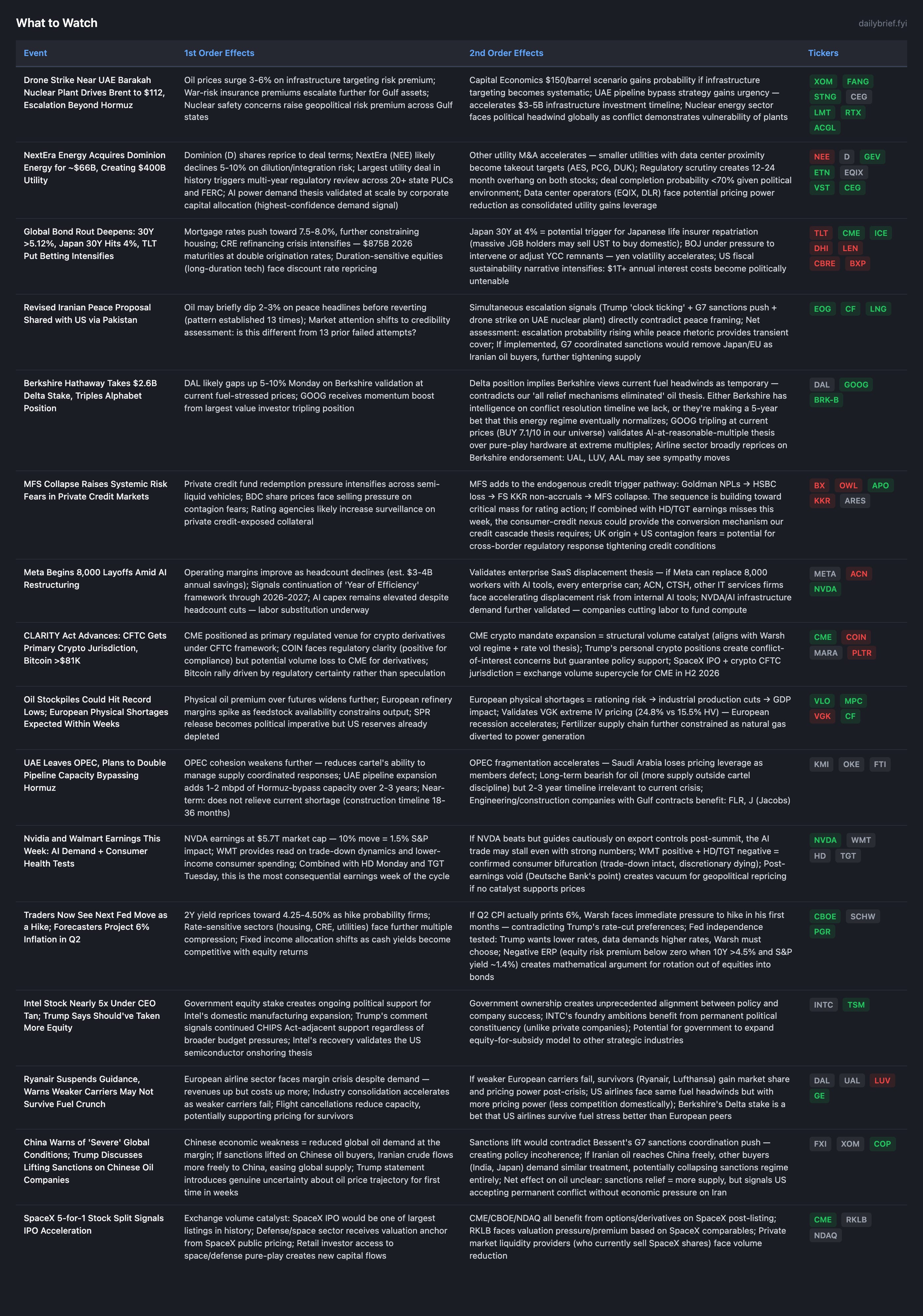
The options market is screaming what credit spreads haven’t yet acknowledged: SPY near-term IV at 24.5% (an 11.4pp spike in three sessions), IWM at 41.0% with a 2.22 put/call ratio pricing catastrophic small-cap outcomes, and GLD’s reversal to 43.9% near-term IV suggesting nuclear infrastructure targeting may be creating a new safe-haven regime we didn’t anticipate at our May 11-12 exit. The credit-equity disconnect — HYG calm at 5.1% while everything else backwardates — either resolves this week through HD/TGT earnings or invalidates the cascade thesis entirely. The positioning framework below identifies specific entry levels, hedge structures, and the probability-weighted scenarios that determine whether Monday’s open is an opportunity or a trap.
Full options positioning analysis, portfolio playbook, and risk scenario framework below for subscribers.
This publication is for informational and educational purposes only and does not constitute financial, investment, or trading advice. The analysis, opinions, and commentary presented here should not be interpreted as a recommendation to buy, sell, or hold any security. Always conduct your own research and consult a qualified financial advisor before making investment decisions. Past performance does not guarantee future results.
