

The two binaries that dominated these briefs for a month resolved this week, both in the directions the daily positioning anticipated, and the net effect is that the dominant near-term driver is now the rate path rather than oil or the Middle East. On Iran, the US and Iran signed a 60-day-extension MoU, the Strait of Hormuz reopened with Saudi-flagged supertankers resuming transit, and crude fell to its lowest since the war began with gas below $4/gallon. This is the first physically verifiable de-escalation in 23 cycles, so the distribution has shifted decisively toward a held reopening. The 72-hour sustained-transit trigger is being met on the physical side, though shipping operators say prewar normalization takes weeks and Trump warned attacks could resume, so the failure tail is reduced but not closed. The 5Y breakeven fell to 2.31 (FRED), confirming the market reads the inflation impulse as deflating.
On rates, Warsh’s inaugural FOMC delivered a hawkish hold, signaled a possible 2026 hike via the dot plot, removed forward guidance, and signaled greater deference to market signals. Equities sold off (S&P -1.2%), yields rose, gold fell ~1%, and the dollar firmed. The forward-guidance removal is the structural change: it raises realized volatility around every data release by removing the Fed’s pre-commitment anchor, and the market-deferential reaction function Morgan Stanley flagged is reflexive in a way that could amplify swings. The two events pull in opposite directions on inflation (Hormuz deflating, hawkish Fed restrictive), which is why the curve flattened (10Y-2Y at 0.29, -0.09) rather than shifting in parallel.
The new signal is on the AI demand and adoption side. Accenture fell to its lowest since 2018 on AI-displacement fears after a Q4 revenue-guide miss, hard confirmation of the services-impairment thesis. JPMorgan cut off Anthropic Claude access for Hong Kong staff, following Goldman Sachs — two banks restricting the same vendor is a multi-source enterprise-adoption-friction data point.
Warsh’s FOMC Is a Communication-Regime Change, Not Just a Hawkish Hold
The Fed held at 3.50-3.75% and the dot plot signaled a possible hike later in 2026, but the structurally important move is the removal of forward guidance and the stated intent to defer more to market signals (Reuters, CNBC, Tier 1-2, multi-source). The mechanism that matters: forward guidance was the Fed’s pre-commitment device that compressed realized volatility around data releases by telling the market what the reaction function was. Removing it means every CPI, payrolls, and PCE print now carries more two-way risk because the market has to re-derive the reaction function each time. This is a direct tailwind to volatility-product and hedging-volume beneficiaries (CME, CBOE, ICE), independent of direction.
The market-deferential reaction function Morgan Stanley warned could backfire is reflexive: if equities rally, the Fed can read it as room to hike; if they fall, as validation of caution. That feedback loop can amplify both directions rather than dampen them. The immediate cross-asset read was clean: equities -1.2%, yields up, gold -1%, dollar firmer, a coordinated higher-discount-rate move. The hawkish guide now rests on labor and services inflation (claims fell to 226K, retail sales beat at +0.9%) rather than the energy-driven headline that is rolling over via Hormuz, which raises the risk the Fed over-tightens into a consumer that the leading indicators say may crack in H2.
For positioning: the dovish-Warsh TLT bet, correctly called stranded for two weeks, is now dead. Higher-for-longer compounds the financing headwind on negative-FCF regulated utilities (AEP, AEE) and compresses alternatives-manager equity multiples (HLNE, APO), though both have offsetting idiosyncratic supports. The Kalshi December-hike market sat at 57% in the provided (June 10) data, but the news flow says bond traders sharply cut hike forecasts after the Iran deal lowered oil; the reconciliation is that lower oil reduces the inflation case for a hike even as Warsh’s tone raises the willingness, leaving the binary genuinely two-sided.
Accenture and Bank Claude Restrictions: Demand-Side AI Signals Multiply
Accenture fell to its lowest since 2018 after a Q4 revenue-guide miss, with the explicit market concern that AI undermines the labor-intensive IT-consulting model (FT, MarketWatch, Tier 2). This is hard-data confirmation of the services-displacement thesis and validates the short leg of the LMT-vs-ACN, BRK.B-vs-ACN, and infra-vs-application pair construction. The bifurcation showed up within the same name: core consulting decelerated while the company announced $4.18B in cybersecurity bookings, confirming security spend is resilient even as labor-arbitrage consulting compresses.
Separately, JPMorgan cut off Anthropic Claude access for its Hong Kong staff, following Goldman Sachs (FT, Tier 2). Two large banks restricting the same AI vendor on data-security grounds is a multi-source enterprise-adoption-friction signal. The mechanism: if regulated-finance adoption faces persistent data-security caution, AI-tool penetration in a high-value vertical slows, which weakens the revenue ramp underwriting the ~$920B hyperscaler capex and raises the exposure on GPU-collateralized credit (Anthropic $35B). Per the analyst lesson to weight demand-side AI signals more heavily than financing-side, these two developments, plus the prior Databricks margin compression and OpenAI usage-plateau, accumulate into a coherent demand-and-adoption question that the next NVDA/hyperscaler print must answer.
The counterweight remains intact at the infrastructure layer: record Korean and Taiwanese chip markets, memory demand outpacing supply (lifting Micron, pressuring Apple), and Apple flagging “unavoidable” price hikes on chip costs all confirm the silicon-demand breadth. The honest read is that the chip layer still shows strength while the application/services layer (ACN, Databricks margins) and the adoption channel (bank restrictions) show friction. LeCun’s bubble warning is opinion, not data, and adds nothing to the evidence base beyond sentiment.
Intel-Apple Design Tie and the Memory Squeeze
Intel jumped 9% on Trump’s statement that it will partner with Apple on US chip design (CNBC, Tier 2, single-sourced from a political comment). If confirmed, this is a meaningful shift in US semiconductor supply-chain sourcing, but it rests on one source and should be treated as variance, not conviction, per the scheduled-catalyst and single-source lessons. It does not threaten TSM’s foundry role near-term even if Apple shifts some design work.
The harder signal is the memory squeeze: analysts expect memory-chip demand to keep outpacing supply, lifting Micron and pressuring Apple’s margins enough that Cook flagged “unavoidable” price increases (MarketWatch, Tier 2). This validates the MU HBM4 roadmap and the broad AI-memory-demand leg, partially countering the inference-off-GPU erosion vector. The consumer-electronics price-hike channel is also a regressive inflation input that compounds the mid-market discretionary crack.
What to Watch
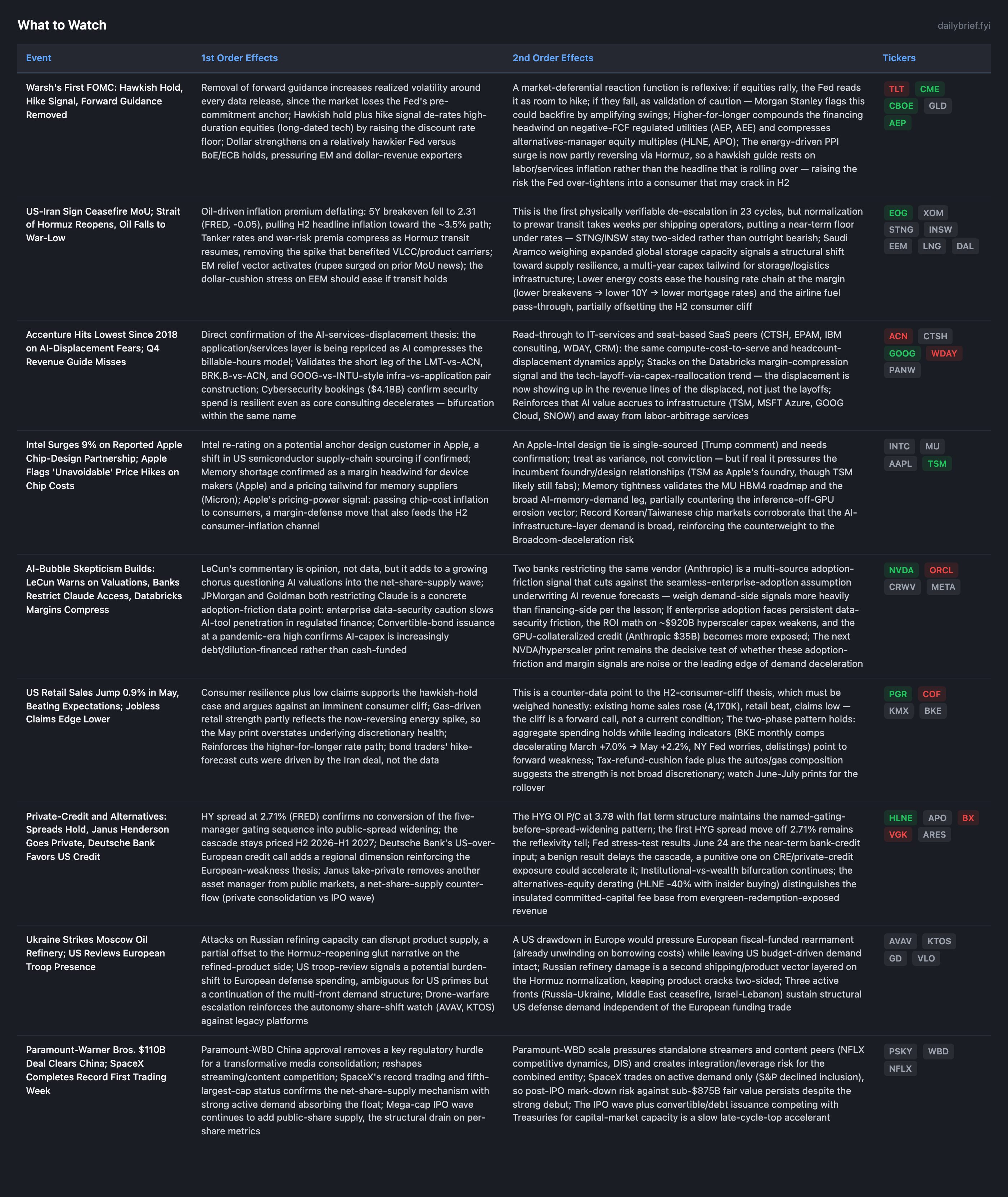
Developing Themes
Iran: Physical Verification Largely Met, Failure Tail Reduced
The signal has crossed from document-plus-tanker-movement (last week) to a signed 60-day MoU, reopened Hormuz, and Saudi supertankers resuming transit, with oil at a war-low and gas below $4 (Reuters, Tier 1, multi-source). The discipline now bends toward action per the lesson, but two factors keep the failure tail alive rather than closed: shipping operators say prewar normalization takes weeks, and Trump warned attacks could resume. Energy moves from HOLD-on-uncertainty toward a reduced war-premium stance; STNG/INSW stay two-sided because weeks-to-normalize transit, SPR-refill demand, and the Russian-refinery-strike product vector provide a floor. Aramco weighing expanded global storage is a structural supply-resilience capex tailwind. A held reopening pulls H2 headline inflation toward 3.5% and eases the housing rate chain and airline fuel pass-through.
Private Credit: No Conversion, Stress-Test Results June 24
HY spread at 2.71% (FRED) confirms the five-manager gating sequence still has not converted into public-spread widening; the cascade stays priced H2 2026-H1 2027. HYG OI P/C at 3.78 with a flat term structure maintains the named-gating-before-spread-widening pattern. Deutsche Bank’s US-over-European credit call adds a regional dimension reinforcing the European-weakness thesis. Janus Henderson’s completed take-private is a net-share-supply counter-flow (private consolidation against the IPO wave). Fed stress-test results June 24 are the near-term bank-credit input. Hold APO/ARES over BX/OWL; HLNE remains the mispriced recurring-fee long.
Net-Share-Supply Wave Confirmed, Active Demand Strong
SpaceX completed a record first trading week as the fifth-largest public company with exceptional volume, confirming the net-supply mechanism with strong active demand absorbing the float (CNBC, Tier 2). Because the S&P declined inclusion, it trades on active demand only, so post-IPO mark-down risk against sub-$875B fair value persists despite the debut. Paramount’s $110B Warner Bros. acquisition clearing China advances a leverage-heavy media consolidation. The IPO-plus-debt-plus-convertible issuance competing with Treasuries for capital-market capacity remains a slow late-cycle-top accelerant.
Continuing Themes
Rates: The binary is now resolved toward hawkish-hold-with-hike-bias and forward-guidance removal; do not pre-position into the reflexive new reaction function. Let CME/CBOE carry the vol. Citadel flags a bumpy two weeks on positioning/flow dynamics.
European stagflation: ECB stays “proactive” (Lane), BoE held at 3.75% in a 7-2 vote, Deutsche Bank expects euro-credit widening. VGK bearish lean intact; German ZEW rebounded on Iran-end hopes, a partial offset.
Power/electrical: GEV, CEG, VST, ETN, AEP overweight intact; data-center load confirmed in regulated-utility hard data. GEV-vs-ORCL pair CORE, Oracle’s negative FCF confirms the short leg.
Consumer: Two-phase read holds; May retail beat (+0.9%) and low claims are current-condition counter-data against the forward-cliff thesis (BKE comps decelerating, delistings, NY Fed worries). PGR over COF, extending to SYF/RDN. Consumer Discretionary BUY-prohibited.
Defense: US multi-front demand intact (Ukraine’s 200-drone Moscow strike, Israel-Lebanon) and separate from the unwinding European funding trade; Hegseth’s troop review ambiguous. Watch autonomy share-shift (AVAV, KTOS).
Crypto: CFTC approved onshore Bitcoin perpetual futures, CLARITY Act faces Senate hurdles before July 4, Illinois enacted a 0.2% digital-asset tax. Structural regulatory positives against waning momentum; no portfolio-relevant change.
Freight: Kearney’s State of Logistics report frames supply-chain volatility as structurally permanent ($2.4T, 7.8% of GDP); reinforces resilience-over-efficiency capex. Amazon LTL disintermediation, UPS the weak leg.
With the two macro binaries resolved, the actionable edge now sits in the cross-asset structure. EEM is still pricing acute downside at 82.1% near-term IV — a 60.2pp gap to historical vol — having only partially bought the Hormuz relief, making it the cleanest relief vector if the 72-hour transit holds. Small-cap structural put dominance survived the de-escalation intact (IWM OI P/C 2.57, -3.4% 12-month skew), the H2 credit window stays priced (HYG OI P/C 3.78 against a tight 2.71% spread), and TLT’s mild backwardation with a call-heavy 0.75 OI P/C confirms the bearish-duration lean as the stranded dovish bets expire. The premium section maps these signals to concrete positioning, the eight-point portfolio playbook, and the seven risk scenarios that frame the highest-leverage open exposures — chief among them the AI demand-and-adoption crack the next NVDA print must adjudicate.
Full options positioning analysis, portfolio playbook, and risk scenario framework below for subscribers.
This publication is for informational and educational purposes only and does not constitute financial, investment, or trading advice. The analysis, opinions, and commentary presented here should not be interpreted as a recommendation to buy, sell, or hold any security. Always conduct your own research and consult a qualified financial advisor before making investment decisions. Past performance does not guarantee future results.
