

The most important development since yesterday’s brief: Target beat Q1 earnings and raised its sales outlook, eliminating the consumer-triggered credit cascade pathway. Combined with HD (Monday) and Lowe’s (today), we now have 3-for-3 consumer earnings beats.
Simultaneously, the structural deterioration thesis intensified: EEM near-term IV widened further to 36.2% (+16.7pp vs HV), the Indian rupee hit a record low near 97/USD, oil dropped below $108 on Trump rhetoric (conforming to the 24-72 hour reversal pattern), and China banned Nvidia’s gaming chip during Jensen Huang’s visit. The Frankfurt CRE deal collapse (€850M, buyer couldn’t finance) provides concrete evidence that 30Y >5% creates nonlinear real-world consequences.
The net picture: near-term US consumer risk reduced, medium-term structural risks (EM crisis, CRE refinancing, multi-channel inflation) unchanged or intensifying.
Target Beat: Consumer Cascade Thesis Requires Material Reassessment
TGT beating and raising guidance with traffic recovery is the single most important development for the credit cascade thesis. The world model assigned 45-55% miss probability based on: lower-income customer base, negative real wages, PPI 6%, new CEO overpromising. The outcome was a beat.
Combined with HD (Pro segment resilient) and Lowe’s (housing maintenance despite rate headwinds), consumer spending is holding across income segments and categories, at least through April/early May. The mechanism “negative real wages → immediate spending collapse” has been empirically falsified for Q1.
However, TGT stock fell despite the beat-and-raise. The market is pricing future margin compression from sustained input cost inflation (PPI 6%) that hasn’t yet fully passed through, plus savings rate drawdown. The consumer is spending but potentially by depleting buffers, converting an acute Q2 risk into a H2 2026 risk.
Credit cascade revised to 40-45% (from 50-60%). The consumer trigger is eliminated. Remaining catalysts: non-consumer credit event, CRE refinancing failure at scale, or BDC/CLO impairment from non-retail exposure.
China Bans Nvidia Gaming Chip: Tech War Escalation at Maximum NVDA Positioning
Beijing banning NVDA’s gaming chip during Huang’s visit is the clearest signal of deliberate timing. The action benefits Huawei and Cambricon domestically while removing $2-3B in NVDA China gaming revenue over time.
This arrives with hedge funds dumping stocks in record numbers ahead of Wednesday’s NVDA earnings, QQQ near-term IV at 26.7% (+10.7pp vs HV), and Samsung strike negotiations breaking down. The semiconductor complex faces three simultaneous risks: geopolitical restrictions, labor disruption, and maximum valuations.
The $90B NVDA investment spree noted by FT represents ecosystem lock-in strategy that partially offsets competitive erosion. But at $5.7T market cap, even a strong beat may generate sell-the-news given institutional de-risking. The contrarian signal (QQQ call skew extreme at nearest expiry) from yesterday has partially normalized but remains relevant.
Frankfurt CRE Deal Collapse: Physical Evidence of Rate Threshold Effects
The €850M OpernTurm acquisition failing because the buyer couldn’t raise financing is the first major concrete evidence that 30Y >5% creates deal-killing constraints in real-time. This is Europe’s largest CRE deal failure since 2022. Combined with BX abandoning the €2.5B Ströer deal, European private market deal-making is functionally frozen.
The mechanism is mathematical: properties valued at 4% cap rates with 3.5% financing create positive leverage. At 5.5% financing, the same properties produce negative cash flow on day one. No rational buyer proceeds.
With $875B in US CRE maturities in 2026 and CMBS distress at 12.07% (all-time high per world model), the Frankfurt collapse is a leading indicator for the US market. The Paramount-WBD $49B debt sale being prepared tests whether credit markets can absorb mega-scale issuance at these yields.
CFTC Probing Oil Futures Insider Trading
The CFTC investigating unusual oil futures trading before Trump’s Iran strike pause became public is novel and has no precedent in this conflict cycle. This creates a new uncertainty layer: if insider trading around geopolitical decisions is occurring systematically, it undermines the information content of futures prices and increases risk premiums for all energy market participants.
This is a single data point but worth monitoring. If the probe reveals systematic information leakage, it would partially explain why our 24-72 hour reversal pattern works — informed traders front-run diplomatic signals that subsequently fail.
Fed Hawkish Chorus: Second Official Endorses Hikes
Paulson joining Collins in explicitly considering rate hikes normalizes the policy option. Two FOMC members (both regional presidents) is sufficient to generate serious discussion at the next meeting. Combined with Warsh swearing-in Friday, Q2 inflation forecast at 6%, and 30Y above 5.1%, the rate hike probability is now 35-45% (Kalshi at 35%). The convergence across personnel, data, and market pricing is the strongest it has been this cycle.
EM Currency Crisis: EEM Widening Further (36.2%)
EEM near-term IV expanded from 34.0% (yesterday) to 36.2% today — a second consecutive day of widening at the most extreme levels tracked. Indian rupee at record low (97/USD, 8th consecutive decline), dollar at 6-week high, Indonesia attempting fiscal discipline that limits stimulus response. The reflexive loop is active and accelerating: oil → trade deficit → currency → sell UST → yields rise → dollar strengthens → EM worsens.
The RBI paying a record ~$35B dividend to the Indian government signals central bank reserves being conscripted for fiscal support — a classic late-stage defense mechanism before currency control is lost.
Oil Price: Conforming to Pattern Despite Noise
Oil dropping below $108 on Trump’s “end war very quickly” rhetoric is signal #15 in the 0-for-14 series. The simultaneous Iran threat to expand conflict “beyond the region” + UK relaxing Russian sanctions to address physical diesel shortages + BPCL shifting to spot buying + FT analysis arguing futures “too sanguine” all contradict the price decline. Per analyst lesson (13x reinforced): require physical verification before adjusting positioning. Six million barrels transiting Hormuz suggests some flow continues but far below the 20M+ bbl/day pre-war baseline.
Russia Revenue Surge Validates Conflict Incentive Structure
Russia’s oil/gas revenue up 39% YoY in May confirms the structural incentive lesson (reinforced 6 times): Moscow has zero financial incentive to facilitate conflict resolution. Combined with Putin-Xi “unprecedented” ties and Power of Siberia 2 advancement, the Russia-China-Iran axis is solidifying economically. De-escalation requires overcoming aligned financial incentives of multiple state actors.
What to Watch
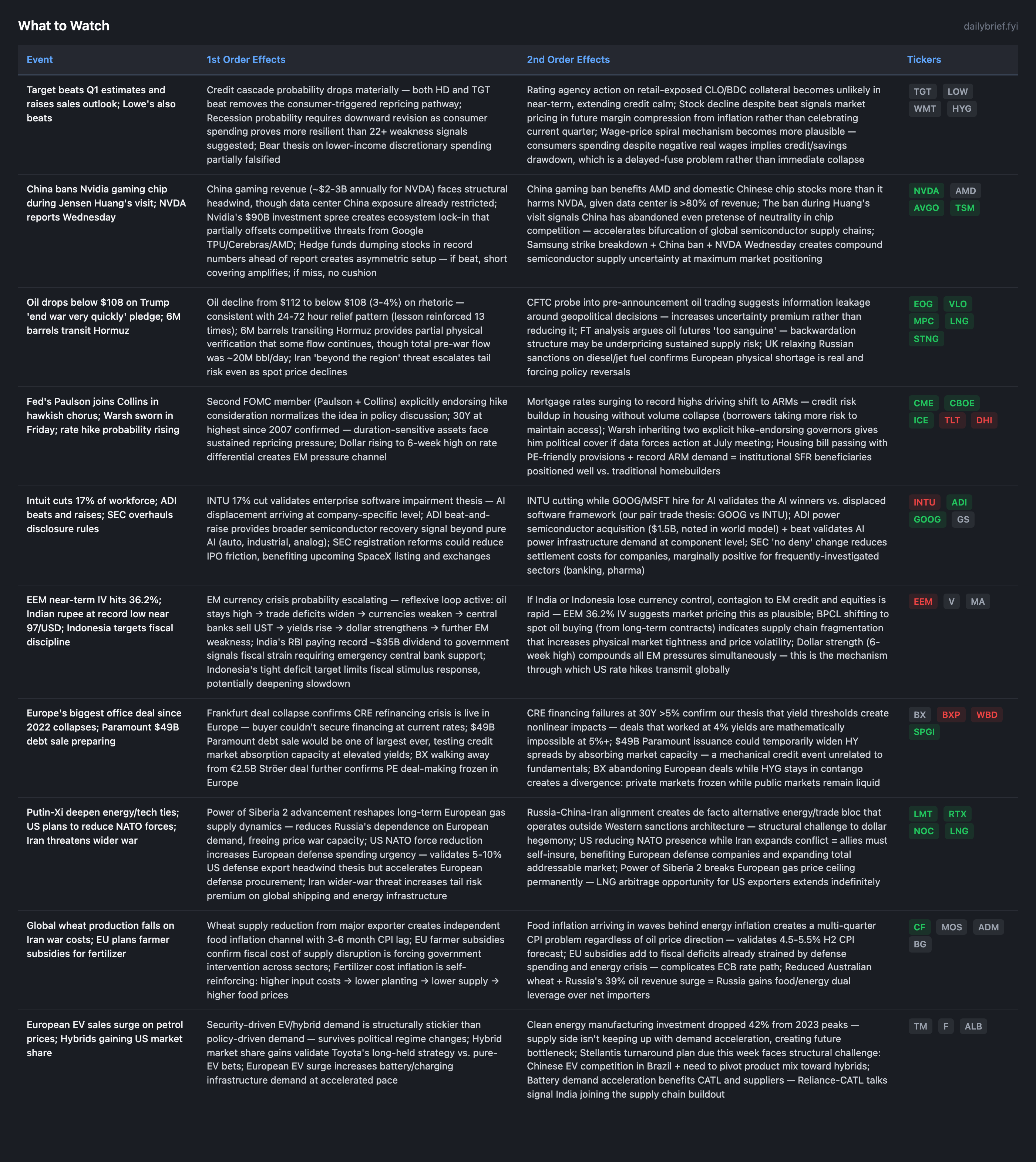
The options market is telling a clear story beneath today’s headlines: QQQ near-term IV widened to 26.7% despite the consumer earnings sweep, with put skew flipping from an extreme -14.6% (call skew) yesterday to +8.6% today — a single-day reversal that signals institutional sentiment has turned decisively bearish ahead of NVDA Wednesday. Meanwhile, HYG’s OI put/call ratio crept higher to 3.97 even as the consumer trigger was eliminated, suggesting institutions are repositioning credit protection toward CRE and institutional pathways rather than removing it entirely. EEM at 36.2% (+16.7pp vs HV) for a second consecutive day represents the most extreme premium across all tracked ETFs — approaching levels that historically precede forced liquidation events. Full options positioning analysis, portfolio playbook, and risk scenario framework below for subscribers.
This publication is for informational and educational purposes only and does not constitute financial, investment, or trading advice. The analysis, opinions, and commentary presented here should not be interpreted as a recommendation to buy, sell, or hold any security. Always conduct your own research and consult a qualified financial advisor before making investment decisions. Past performance does not guarantee future results.
