

The 72-hour Hormuz confirmation window has entered Day 3 (expiring today, May 28). The dominant development: oil fell 6% on the Iran deal framework, then partially reversed on simultaneous US strikes, with markets net choosing the deal narrative (S&P/Nasdaq records, yields -6bp from peace-day lows). Today’s fresh data confirms the world model’s coercive diplomacy framework — strikes and negotiations proceeding in parallel.
Three genuinely new signals emerged: (1) China resuming urea exports adds a third independent headwind to the fertilizer premium thesis (joining Hormuz resolution potential + EU duty suspension), (2) Micron crossing $1T market cap with NVIDIA confirming $150B in capex plans validates AI infrastructure demand at scale but places semiconductor valuations at maximum fragility, and (3) HYG options P/C has intensified to 3.61 OI with a volume spike to 6630x — the most extreme credit protection positioning measured in this cycle, occurring while HY spreads tightened to 2.72% (FRED).
The macro regime remains stagflationary with a binary near-term resolution vector. FRED data confirms: Fed Funds 3.64%, 2Y at 4.13% (49bp above policy rate = market pricing hike), 10Y at 4.56%, HY spread 2.72%. The gap between monetary policy and market rates is the widest since the hiking cycle ended.
China Urea Export Resumption: CF Industries Thesis Deteriorating from Three Directions
China permitting fresh urea exports (Reuters Tier 1, May 27) represents the third independent headwind to the nitrogen fertilizer premium thesis within 10 days. The evidence base:
Hormuz resolution potential (25-30%): If deal closes, energy-driven fertilizer premium moderates
EU fertilizer duty suspension: European import costs decline
Chinese urea supply restoration (new, confirmed): Largest global urea producer resuming exports into a supply-constrained market
Combined, these represent a structural shift in the nitrogen supply-demand balance. CF at ~11x fwd EPS of $18 (Hormuz-inflated) faces EPS compression to $9-11 if all three headwinds materialize simultaneously. At $122, downside to $95-105 represents 14-22% risk.
The CF vs CPB pair trade should be reviewed. CF’s original thesis was “structural nitrogen scarcity from Hormuz closure.” The scarcity is being addressed from multiple directions simultaneously. This is the first time the evidence against CF exceeds the evidence for it.
Micron at $1T + NVIDIA $150B Capex: AI Infrastructure Validated but Fragility Maximized
MU and SK Hynix simultaneously crossing $1T confirms the AI memory thesis has been fully priced by markets. The relevant question is now whether current pricing is sustainable given correction conditions.
The correction setup remains: SOX +50% in 25 trading days + hedge fund tech positions at record since 2016 (Goldman data) + SpaceX IPO June 12 creating forced rotation + QQQ near-term IV at 28.9% (vs 15.9% HV). The semiconductor correction probability of 40-50% within 2-4 weeks is unchanged, but the base from which correction occurs is now higher ($1T MU, not $800B MU).
NVIDIA’s $150B spending announcement directly benefits TSM (primary foundry), Samsung (HBM), and equipment vendors (ASML, LRCX, AMAT). It does not change the fragility assessment — it confirms demand while concentration and valuation risk remain elevated.
HYG Volume/OI Divergence at Cycle Extreme
Today’s HYG data shows P/C volume ratio at 6630.7x (effectively all volume is puts) with OI P/C at 3.61. This is the most extreme single-day volume divergence measured. Spreads simultaneously tightened to 2.72% (FRED, -0.02).
Interpreting this signal requires the analyst lesson (9x reinforced): extreme OI spikes without spread movement indicate hedging demand rather than informed positioning. Conversion requires declining primary market access or a specific default/downgrade event. The Paramount $49B absorption + WBD-Paramount adversarial phase (lawyers hired) is the most plausible near-term conversion catalyst.
However, leveraged loan earnings growing fastest since 2022 (today’s data) partially explains why spreads stay tight — fundamentals supporting pricing while institutions hedge the tail. The WSJ’s “priced to perfection” characterization is accurate: any credit event reprices from an extremely tight base, amplifying the move.
Robinhood AI Agent Trading: Market Microstructure Implication
Robinhood enabling AI agents to execute trades with minimal human involvement represents a structural change in retail market microstructure. If adopted at scale, this could: (1) increase transaction frequency per account (benefiting exchanges), (2) create algorithmic herding effects if many agents use similar strategies, (3) attract regulatory scrutiny for autonomous retail trading without human oversight.
This is a single data point — monitoring status only. It represents the first platform allowing autonomous AI trading for retail accounts. If successful, competitors (SCHW, IBKR) will follow within quarters.
What to Watch
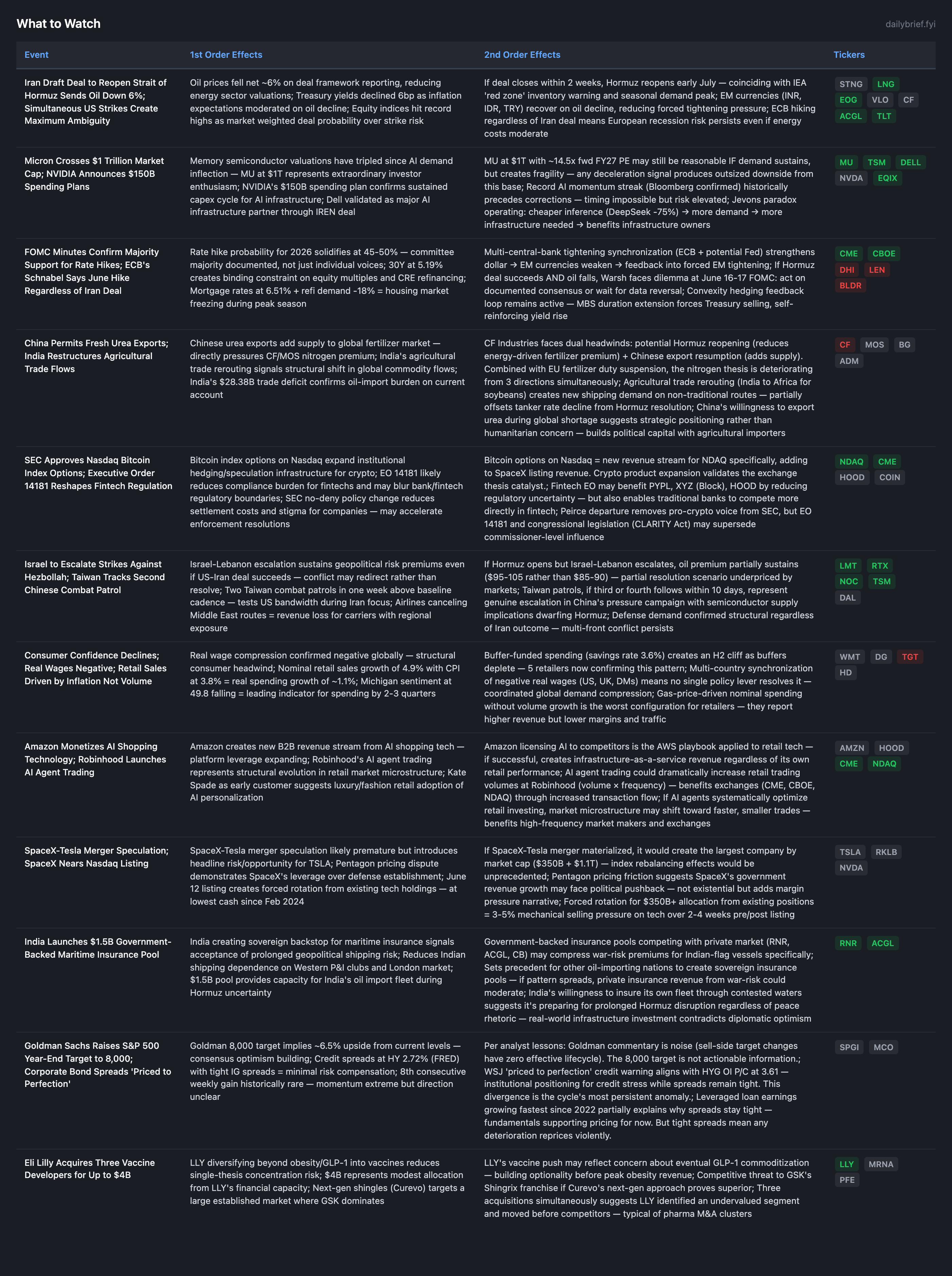
Developing Themes
Hormuz 72-Hour Window: Day 3 — Decision Point
The window expires today (May 28). Current evidence: 7 concurrent de-escalation indicators (tanker transit, deal framework, Iran envoys, Gulf markets, oil decline, INR recovery, Iran’s 30-day timeline) vs. simultaneous US strikes + tanker explosion off Oman + Trump “no rush” comment. Net balance unchanged from prior brief — strikes and deal co-existing in coercive diplomacy mode.
If 3+ additional tankers are confirmed transiting by end of day, begin conditional energy position reductions per the framework. If transit halts or new escalation occurs, maintain maximum overweight. The 30-day Hormuz reopening timeline (if deal closes) places physical reopening in early July — coinciding exactly with IEA’s inventory “red zone” warning.
Rate Hike Path: Warsh’s First FOMC in 20 Days
ECB’s Schnabel (Tier 1) explicitly stated hikes proceed regardless of Iran outcome. If both ECB and Fed hike in June-July while BOJ continues easing, dollar strengthens further, EM currencies weaken, and the forced tightening cycle (Sri Lanka +100bp) spreads to additional countries.
Warsh’s “patient hawk” AI-productivity thesis is the key variable. If he delays despite committee majority, market reprices lower (TLT rally). If he acts, 2Y gaps toward 4.5%.
SpaceX IPO: 16 Days to Forced Rotation
Goldman data confirming hedge fund tech positions at record highs since 2016 means the allocation for SpaceX ($350B+) must come from liquidating existing holdings. Pentagon pricing dispute adds a new friction dimension — SpaceX’s government revenue faces political pushback. The SpaceX-Tesla merger speculation is noise (no confirmed talks, speculative commentary only).
Continuing Themes
Consumer H2 cliff: 5 retailers confirmed. Real wages negative globally (US, UK, DMs). Michigan sentiment 49.8 falling. Buffer-funded Q2 holds; H2 vulnerability 40-50%. No change.
Credit markets: HYG positioning at cycle extremes. Cascade probability 35-45% via institutional pathway. No change in structure.
Defense: Multi-front conflict confirmed (US strikes + Israel-Lebanon + Taiwan patrols). Demand structural. No change.
Enterprise software impairment: DeepSeek 75% permanent cut. No new company-specific data point today. Thesis intact at 7+ confirmations.
Taiwan Strait: Second combat patrol in one week. FXI options still not pricing escalation (OI P/C 1.09, neutral). Monitoring status maintained — third patrol within next 5 days would upgrade risk assessment.
Today’s options scan reveals several signals demanding attention: IWM $260 puts for July 2 at 68x Vol/OI represent a specific institutional bet on a 10.7% small-cap decline within 5 weeks — the most actionable directional signal in the data. HYG’s newly established contango structure (5.2% near-term vs 8.0% 12-month) prices material credit stress arriving H2 2026, while QQQ’s 3-month P/C volume ratio of 2.19 confirms the SpaceX rotation and semiconductor correction window is being actively hedged by institutions. The premium section details how to position around these signals, including conditional energy reductions, CF downgrade rationale, and the five risk scenarios spanning Hormuz resolution through credit stress materialization.
Full options positioning analysis, portfolio playbook, and risk scenario framework below for subscribers.
This publication is for informational and educational purposes only and does not constitute financial, investment, or trading advice. The analysis, opinions, and commentary presented here should not be interpreted as a recommendation to buy, sell, or hold any security. Always conduct your own research and consult a qualified financial advisor before making investment decisions. Past performance does not guarantee future results.
