

The 72-hour Hormuz confirmation window has expired with a clear result: deal failure confirmed. US and Iran exchanged airstrikes on May 28, Trump dismissed reports of a Hormuz MOU, and the ceasefire is collapsing. This is the 16th failed de-escalation signal in this conflict cycle, fully consistent with the analyst lesson (13x reinforced): discount vague diplomatic signals, require physical verification.
Three genuinely new signals today: (1) Q1 GDP revised down to 1.6% from 2.0%, confirming growth deceleration while inflation holds at 3.8% PCE — the stagflation diagnosis is now official government data, (2) Snowflake +36% on $6B AWS deal introduces a meaningful bifurcation within the software impairment thesis (infrastructure strong, applications weak), and (3) consumer distress is being quantified via 401k hardship withdrawals — a structural signal that spending buffers are being depleted from the deepest reserves, not just savings accounts.
The Hormuz window failure means: energy maximum overweight validated (do NOT execute conditional reductions), rate hike probability maintained at 45-50% (inflation catalyst persists), and the 30Y at 5.2% represents the binding constraint on equity multiples per the analyst lesson on yield thresholds.
GDP Revised to 1.6%: Stagflation Now In Official Data
The Q1 GDP downward revision from 2.0% to 1.6% while PCE holds at 3.8% places the US economy officially in the stagflationary quadrant:
Corporate profit slowdown (cited as revision cause) will flow into Q2-Q3 earnings estimate reductions
GDP at 1.6% with 3.8% inflation means the real economy is growing at perhaps 0.5-1.0% adjusted for price level — functionally stalling
Three Fed officials on the same day (Jefferson, Kashkari, Goolsbee) all prioritizing inflation over growth confirms the policy stance won’t shift to accommodate slowing growth
The PCE release being “better than feared” at 3.3% core (in-line) temporarily supported futures, but 3.3% core is still 65% above the 2% target, and the headline at 3.8% reflects embedded energy inflation that doesn’t resolve while Hormuz remains closed.
For Warsh’s June 16-17 FOMC: he inherits 1.6% growth + 3.8% headline inflation + three committee members on record supporting hikes + 30Y at 5.2%. The “patient hawk” thesis now faces its first formal test. If he waits, he signals tolerance for above-target inflation. If he acts, he risks tipping the 1.6% growth into contraction.
Snowflake +36%: Software Bifurcation Thesis Clarified
SNOW’s record-day surge on a $6B AWS commitment clarifies the enterprise software picture. The impairment thesis (7 data points: INTU layoffs, DeepSeek cuts, ServiceNow weakness, etc.) applies to application-layer SaaS — CRM, WDAY, INTU. Snowflake is data infrastructure — fundamentally different in that it enables AI workloads rather than being displaced by them.
This doesn’t change the pair trades (GOOG vs INTU, TSM vs WDAY, PANW vs CRM remain valid) but it refines the thesis: companies building the infrastructure for AI thrive; companies whose products AI can replace face margin compression. SNOW sits on the right side of that divide.
The $6B Arm-based (Graviton) commitment also validates the Arm architecture thesis at enterprise scale — not just mobile/edge.
401k Hardship Withdrawals: Depleting the Deepest Buffer
Fidelity reporting increased hardship withdrawals from retirement accounts represents a qualitative shift in consumer distress signals. The consumption buffer sequence: (1) excess savings → depleted, (2) credit expansion → active, (3) savings rate compression → 3.6%, (4) retirement account raids → confirmed today.
This also creates a structural negative feedback: every dollar withdrawn from 401k is a dollar removed from future market inflows — reducing equity demand at the margin precisely when AI positioning is at maximum.
What to Watch
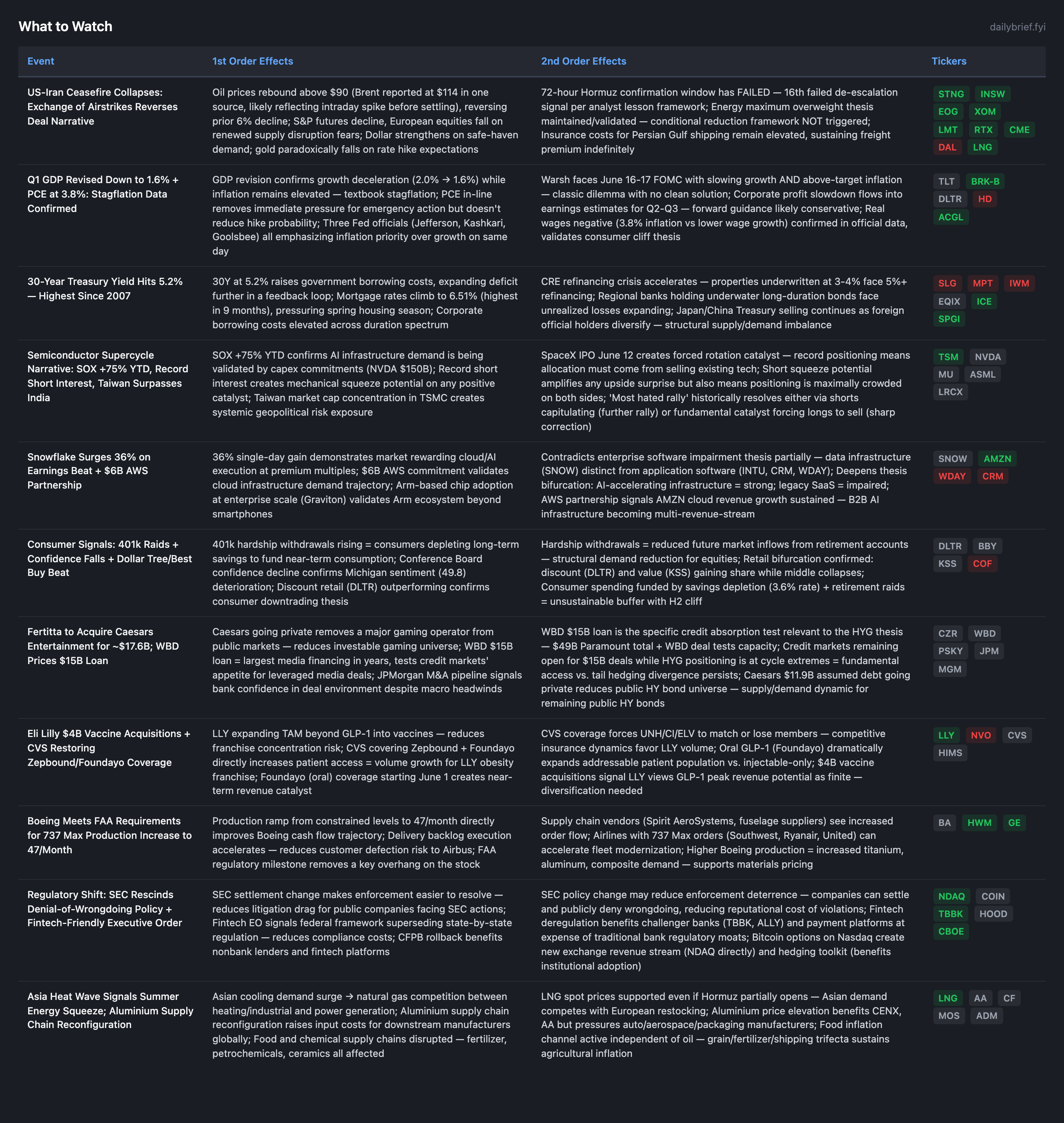
Developing Themes
Hormuz: 16th Failed Signal — Base Case Confirmed
The 72-hour window has expired with escalation rather than confirmation. Per the pre-committed framework: do NOT execute energy position reductions. The conditional framework (if 3+ tankers by May 28 → reduce) was NOT triggered because:
Trump dismissed the deal framework
Active military exchanges continued (Iran targeted US airbase)
Kuwait intercepted missiles — third-party state involvement
Tanker explosion off Oman confirmed
If any new peace signal emerges, it starts from zero credibility given 16 failures. The threshold for the next conditional reduction trigger should be elevated to sustained transit (72+ hours of uninterrupted commercial shipping) rather than a single diplomatic announcement.
Rate Path: Committee Alignment Strengthening
Four Fed voices in two days (Waller, Jefferson, Kashkari, Goolsbee) all emphasizing inflation priority. The bond market concurs: 2Y at 4.01% vs Fed Funds 3.64% = 37bp gap. With GDP at 1.6% and Hormuz confirmed closed, the committee argument for action strengthens into June.
Warsh’s dilemma: AI productivity thesis argues for patience, but if he doesn’t hike while three committee members advocate it, he signals either independence from consensus or a framework the market hasn’t priced. Either creates vol.
Credit Markets: WBD $15B Loan Tests Capacity
WBD pricing a $15B loan facility successfully is the specific test identified in the world model for credit market access. Access remaining open at scale ($15B single facility + $18B prior single-day issuance) while HYG OI P/C sits at 4.46 confirms the analyst lesson: positioning intensity without simultaneous access deterioration does not force spread repricing. The credit cascade timeline remains H2 2026 - H1 2027 per HYG contango signal, not imminent.
Continuing Themes
Semiconductor correction setup: SOX +75% YTD per FT, “most hated rally in history.” Fragility maximized but no trigger yet. SpaceX June 12 remains the forcing function. No change in 40-50% correction probability within 2-4 weeks.
Consumer H2 cliff: 401k raids confirm buffer depletion. DLTR/KSS beats confirm downtrading. Timeline unchanged: Q2 holds, H2 vulnerability 40-50%.
Defense demand: US-Iran strikes + Israel-Lebanon escalation + NATO Baltic buildup. Multi-front structural. Maximum conviction maintained.
Small-cap avoidance: IWM P/C volume at 2.38, OI at 2.07. July 2 $260 put thesis intact. Do not add small-cap exposure.
CF Industries: Deal collapse partially removes one of three headwinds (Hormuz resolution potential now back to 25-30%, not 50%+). But China urea exports + EU duty suspension still active. Maintain 5.5/10 downgrade. Do not rebuild position.
Today’s options market is sending a precise and actionable message: SPY near-term IV remains flat at 17.4% despite active military strikes, yet IWM IV spiked +2.8pp with put/call volume at 2.38 — the market is selectively pricing risk rather than broadly repricing. The most striking single signal: TLT $90 calls for June 18 trading at 22.4x Vol/OI, representing a specific institutional bet that Warsh surprises dovish at the June FOMC despite four hawkish Fed voices this week. Meanwhile, HYG contango has now been confirmed for three consecutive sessions with OI P/C at 4.46, validating a structural credit stress timeline of 6-12 months. The premium section details how these signals translate into position sizing, conditional triggers, and the five risk scenarios (ranging from 20% to 50% probability) that frame portfolio construction through June FOMC.
Full options positioning analysis, portfolio playbook, and risk scenario framework below for subscribers.
This publication is for informational and educational purposes only and does not constitute financial, investment, or trading advice. The analysis, opinions, and commentary presented here should not be interpreted as a recommendation to buy, sell, or hold any security. Always conduct your own research and consult a qualified financial advisor before making investment decisions. Past performance does not guarantee future results.
