

The landscape is largely a confirmation of last week’s resolved binaries rather than a new regime. The two month-long binaries — Hormuz and the Warsh FOMC — are resolved, and today’s events fill in their consequences. Brent settled below $80 with the 5Y breakeven at a series-low 2.27 (FRED), while the 2Y hit 4.20% and the 10Y 4.49% as the Warsh hawkish-hold-plus-guidance-removal repriced duration higher. The net is unchanged from last week: a higher discount rate sitting on a deflating energy-inflation impulse, which is why the curve flattened to 0.27 rather than shifting in parallel.
Three developments add genuine information. First, Iran’s Tehran-approved-insurance demand and 400+ ships waiting offshore confirm the transit-fee/floored-oil regime as the operative baseline — crude is floored above ~$80 with a reduced-but-live 60-day failure tail, not the open/closed binary. Second, the Accenture 17% drop, dragging Indian IT down up to 7%, is the hardest single-name confirmation yet of the AI-services-impairment thesis, with the $4.18B cybersecurity bookings inside the same print validating both legs of multiple pairs. Third, the AI trade’s rotation into memory and semi-cap equipment (Micron surged, hyperscalers lagged), combined with Nvidia’s $25B IG bond sale and shrinking Big Tech buybacks, sharpens the infrastructure-layer-breadth-versus-net-share-supply tension heading into the late-July NVDA print. The new structural signal is the convergence of three independent de-dollarization data points (yuan internationalization, Brazil panda bonds, US-ally realignment) in a single day, an upward pressure on the US long end coincident with the carry-unwind and record issuance supply.
The Transit-Fee/Floored-Oil Regime Is Now the Operative Baseline
Iran’s monetize-not-close move arrived as policy. The same window that produced the signed interim deal and Hormuz reopening also produced Iran’s demand for Tehran-approved insurance to transit, a cancelled Switzerland follow-up, Trump’s renewed-strike threat tied to Hezbollah, and 400+ vessels waiting offshore for a stronger ceasefire (FT, Reuters, Tier 1-2, multi-source). The mechanism: an insurance-fee wedge raises the effective cost of transit without closing it, which floors crude above ~$80 and supports tanker rates even as the acute war premium deflates. Lloyd’s and Chubb launching a Hormuz marine war-risk consortium institutionalizes the elevated-premium regime. Treasury authorizing Iranian oil sales through August adds marginal supply that caps the upper tail.
This resolves the oil-direction question from open/closed into glut-versus-floor, a narrower and lower-volatility band. The deflating energy-inflation impulse pulls H2 headline toward 3.5% on a held reopening, against the 4.5-5.5% failure path. The failure tail is reduced but live across the 60-day window — multi-decade-low inventories keep the $150-160 tail severe if it breaks. STNG/INSW stay two-sided for a structural reason: route normalization compresses ton-miles (bearish) while the insurance wedge floors rates (offsetting). The conflict’s economic damage unwinds over months even as supply fears recede, so this is reduce-the-war-premium, not go-outright-bearish.
Accenture’s 17% Drop Broadens the Services-Impairment Signal to the Global IT Complex
Accenture cut its revenue forecast and fell to its lowest since 2018, citing Iran-war client-demand weakness, with the market reading AI as undermining the labor-arbitrage consulting model (Reuters Tier 1, Seeking Alpha Tier 3). The selloff broadened the signal from one company to the global services complex and confirms the short leg of the LMT-vs-ACN, BRK.B-vs-ACN, GOOG-vs-INTU, and TSM-vs-WDAY pairs.
The within-name bifurcation is the underrated detail: core consulting decelerated while Accenture disclosed $4.18B in new cybersecurity bookings. AI compresses the value of labor-intensive consulting and seat-based software while the attack surface grows with AI adoption — one earnings report validates both the services short leg and the security-wins long leg (PANW, FTNT). Per the lesson to weight demand-side AI signals above financing-side, this plus the two-year-high tech layoffs and rising continuing claims (1.81M, +24K, FRED) matters more than the continued AI-debt issuance. The counterweight remains the infrastructure layer, which is why the late-July NVDA print is the decisive arbiter of whether the chip layer holds while services crack.
The AI Trade Rotates Into Memory and Semi-Cap as Buybacks Shrink and Issuance Builds
Three corporate-finance data points sharpen the net-share-supply thesis. The AI trade has rotated into memory (Micron surged) and semiconductor capital equipment, leaving hyperscalers behind (CNBC, Tier 2). Big Tech buybacks are shrinking as AI capex consumes cash (Bloomberg, Tier 2). Nvidia returned to the public bond market with a $25B IG sale, its first since 2021 (Forbes, Tier 3), adding to Oracle’s $20B and Amazon’s C$14B.
The mechanism connecting these: capex-intensity is converting capital-light tech into capital-intensive tech, eroding the per-share-buyback support that propped valuations for two decades, while IPO supply (SpaceX) and AI-purpose debt build on the other side. This confirms the US public-share count stops shrinking for the first time in 23 years. The memory leadership caps the MU monopoly narrative as a commodity-pricing event — the all-three-supplier HBM4 qualification means this is broad pricing, not durable monopoly, keeping MU two-sided into the June 24 print. NVDA’s IG raise is the favorable funding mechanism (debt over dilution), but it deepens the circular-financing web where NVDA increasingly funds its own demand. The Microsoft-Chevron Texas data-center gas deal is a second independent data point (after Siemens Energy) that data-center power demand is spilling into natural gas, reinforcing the power-bottleneck overweight (GEV, CEG, VST) and adding a marginal gas-demand vector to CVX.
De-Dollarization Reaches Three Independent Data Points in One Day
China announced yuan-internationalization measures (Reuters, Tier 1), Brazil will issue yuan-denominated panda bonds (SCMP, Tier 3), and the FT reports US allies are reconsidering economic ties (Tier 2). Stacked with $27B of EM outflows in May (China diverging at +$8.1B) and gold’s persistent reserve-asset bid, these three independent de-dollarization data points converged in a single day. Per the lesson to track cumulative signal clusters rather than isolated points, this de-dollarization vector has been under-aggregated; it is an independent structural upward force on the US long end (reduced foreign Treasury demand) that compounds the carry-unwind (yen at a 40-year low) and the record IPO/debt issuance competing for capital. The ally-realignment leg is FT-single-framing and early; monitor for trade-flow confirmation rather than building conviction. The cumulative effect supports the structural gold bid and the bearish-duration lean independent of the Fed.
What to Watch
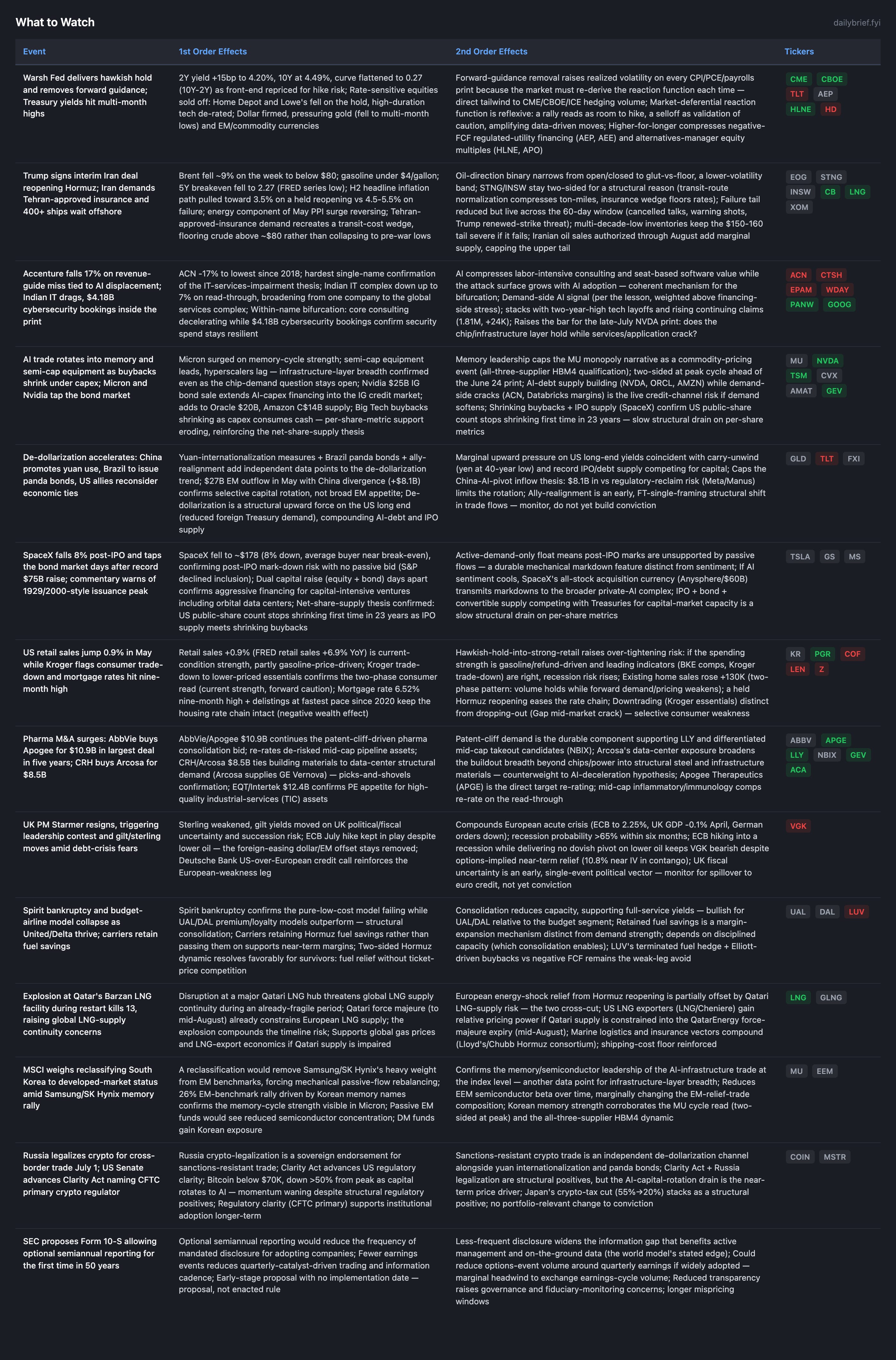
Developing Themes
Private Credit: Spread at 2.63%, No Conversion, Stress Tests June 24
The FRED HY spread tightened to 2.63% (-0.08), confirming the gating sequence still has not converted into public-spread widening; the cascade stays priced H2 2026-H1 2027. Deutsche Bank’s US-over-European credit preference reinforces the European-weakness leg. The building AI-debt supply (Oracle, Amazon, Nvidia) is the live credit channel if demand softens (the ACN/Databricks demand-side cracks are the relevant counterweight to absorption). HYG OI P/C at 3.03 with a flat-to-slightly-backwardated term structure prices near-term calm against H2 stress. Fed stress-test results June 24 are the near-term bank-credit input; the first HYG spread move off 2.63% remains the reflexivity tell. Hold APO/ARES over BX/OWL; HLNE the mispriced recurring-fee long.
Net-Share-Supply Wave: SpaceX to Break-Even, Bond Raise Confirms Capital Intensity
SpaceX fell ~8% to ~$178 (average buyer near break-even) and launched a bond offering days after its record IPO, disclosing ~$100.8B cash (CNBC/MarketWatch, Tier 2). This confirms the predicted post-IPO mark-down with no passive bid (S&P declined inclusion) and the aggressive dual-channel financing for capital-intensive ventures. The Tesla-merger speculation from an amended filing is single-sourced interpretation noise; near-zero weight per the source-tiering lesson. The IPO-plus-debt-plus-convertible supply remains a slow late-cycle-top accelerant.
European Stagflation: ECB Stays Hawkish, UK Adds Political Risk
ECB’s Wunsch kept a July hike in play despite lower oil, and Starmer’s resignation adds UK political/fiscal uncertainty (sterling dipped, gilts moved). The foreign-easing dollar/EM offset stays gone; recession probability >65% within six months. VGK options show near-term relief (10.8% near-IV in contango, cheap vs 16.0% HV) that I continue to read as premature given the ECB-hike-into-recession setup and Deutsche Bank’s euro-credit-widening call. The first euro-credit spread move is the confirming tell the bearish fade needs.
Continuing Themes
Consumer: Two-phase read intact. May retail +0.9% (FRED +6.9% YoY) and existing home sales +130K are current-condition strength; Kroger’s trade-down flag, mortgage rates at 6.52%, delistings at the fastest pace since 2020, and Michigan at 49.8 are the forward-cliff tells. Hawkish-hold-into-strength raises over-tightening risk. PGR over COF, extending to SYF/RDN. Consumer Discretionary BUY-prohibited.
Defense: Multi-front demand intact; the $80B Pentagon supplemental request and continued Hezbollah sanctions sustain the structural overweight, separate from the unwinding European funding trade. MDA/Blue Canyon and the space/autonomy share-shift watch (AVAV, KTOS) continue.
Power/electrical: Overweight reinforced by the Microsoft-Chevron gas deal and the CRH/Arcosa data-center-materials read-through. GEV, CEG, VST, ETN, AEP intact; GEV-vs-ORCL pair CORE.
Healthcare M&A: AbbVie/Apogee $10.9B (largest in five years) continues the patent-cliff consolidation bid; supports LLY and differentiated mid-caps (NBIX). The durable component is M&A demand.
Airlines: Spirit bankruptcy confirms budget-model collapse; UAL/DAL premium models thrive and retain Hormuz fuel savings. LUV the weak-leg avoid.
Crypto: Bitcoin below $70K, down >50% from peak on AI-capital rotation; Russia legalization and Clarity Act advancing are structural positives against waning momentum. No portfolio-relevant change.
Freight: Container Port Performance and State of Logistics reports frame supply-chain volatility as structurally permanent; reinforces resilience-over-efficiency capex. Amazon LTL disintermediation, UPS the weak leg.
The options structure now reads cleaner than at any point in the prior two weeks, and four durable signals survive the noise: the QQQ -3.1% 12-month AI-tail skew sitting beneath a calm front end, the IWM structural small-cap put OI at 2.31 with fresh June downside (the June 25 $288 put at 13.5x volume/OI), the H2 credit window in HYG (OI P/C 3.03, -6.5% 12-month skew, the deepest in the macro set), and the EEM front-end re-stress (39.1% near-IV, 42.94 volume put/call) that reflects dollar/Iran-fragility two-sided repricing rather than a clean directional break. The premium section maps these into a concrete playbook — where to hold high-conviction infrastructure against the cracked services layer, how to size the bearish-duration lean as de-dollarization compounds the carry-unwind, and which June 24 catalysts (Micron, the Fed stress tests) become reflexivity tells. Full options positioning analysis, portfolio playbook, and risk scenario framework below for subscribers.
This publication is for informational and educational purposes only and does not constitute financial, investment, or trading advice. The analysis, opinions, and commentary presented here should not be interpreted as a recommendation to buy, sell, or hold any security. Always conduct your own research and consult a qualified financial advisor before making investment decisions. Past performance does not guarantee future results.
