

The options market has de-escalated sharply since Sunday night. SPY near-term IV collapsed from the 28.1% reported in the prior brief to 12.5% today — below historical volatility and back into contango. This reversal was driven by VP Vance’s “a lot of progress” comment on Islamabad peace talks and a temporary oil pullback. Meanwhile, the actual operational picture worsened: the US naval blockade is active, a shadow-fleet tanker is testing enforcement, NATO allies refused to participate, and the IEA formally projected both supply and demand contraction for 2026. The market has once again normalized equities while credit (HYG OI P/C still at 4.65) and international markets (EWJ 30.5%, VGK 23.8%, EEM 30.5% — all in backwardation) remain stressed. This is the same divergence pattern identified as mispricing on April 9 and again on April 13, now reproduced for the third time.
The key new data today: (1) March PPI rose 0.5% vs 1.1% consensus — energy-concentrated, core tame — providing modest near-term dovish signal while confirming the inflation pipeline is full; (2) JPMorgan, Citigroup, and BlackRock reported strong Q1 earnings driven by trading volatility, with Dimon issuing his most explicit warning yet about economic complexity; (3) Amazon’s $11.5B Globalstar acquisition reshapes the satellite connectivity market; (4) Congo copper/cobalt mining disrupted by Iran war chemical supply cuts — a third-order supply chain effect; (5) European airlines formally requesting EU intervention on jet fuel supply, confirming the 2-3 week shortage timeline.
PPI: Energy-Concentrated Inflation With Tame Core
March PPI at +0.5% (vs +1.1% consensus) is the first genuinely mixed inflation signal in weeks. The headline hit a 3-year high on energy, but ex-energy prices were contained. Two analytical implications:
First, this does not change the April CPI trajectory. PPI measures producer costs; CPI measures what consumers pay. The 4-6 week lag between producer input costs and retail prices means the diesel at $5.29/gallon, shipping surcharges, and petrochemical costs already in the PPI pipeline will flow into April and May CPI regardless of the below-consensus headline. The 65-75% probability of April CPI >4.0% is unchanged.
Second, the energy-concentration pattern means margin compression will be uneven across sectors. Energy-intensive industries (chemicals, airlines, trucking, logistics) face severe cost passthrough. Services and tech firms with low direct energy input face manageable headwinds. This supports the sector-level positioning: overweight energy producers (price takers), avoid energy consumers (price payers), maintain quality in services.
JPMorgan highlighted Eastman Chemical (EMN) as a direct beneficiary of Iran war supply disruption — higher prices for several chemicals it produces. This represents only a single sell-side call (1 data point) and does not warrant conviction.
Bank Earnings: Trading Wins, Lending Uncertain, Warnings Intensify
JPMorgan’s record market revenue and Citigroup’s best quarter in a decade validate the exchange/volatility beneficiary thesis that has been core to the portfolio framework since the conflict began. The mechanism is straightforward: geopolitical volatility → client hedging activity → trading revenue. CME, ICE, and CBOE are the purest expressions of this.
The more significant signal is JPM’s NII weakness combined with Dimon’s “increasingly complex risks” warning. This is now the 5th cautionary statement from major bank leadership during the crisis (after Dimon’s annual letter, the JPM March 11 markdown, the “larger than feared” private credit warning, and the Muddy Waters credit short pivot). When the largest banks consistently warn about risk, they are signaling their own lending behavior is becoming more conservative, which itself contributes to the credit tightening dynamic.
BlackRock’s $13.89T AUM and “strongest start” framing obscures the private credit stress sitting underneath the headline numbers. HPS private credit redemptions (~1.2% of AUM but ~7% of base fee revenue) are the risk to monitor. The BLK BUY thesis at ~18x adjusted forward remains intact but requires monitoring of the Q2 private credit fund flow data.
Wells Fargo maintaining guidance through the oil shock is the most operationally useful signal for bank positioning: conservative management teams that don’t chase upside in volatile environments tend to outperform when credit stress materializes.
Amazon-Globalstar: $11.5B Satellite Bet
Amazon’s acquisition of Globalstar for $11.5B is the company’s largest deal since Whole Foods and represents a genuine strategic commitment to LEO satellite connectivity. The deal matters for three reasons beyond the headline:
Capital allocation prioritization. Amazon is simultaneously spending on AI infrastructure (Project Kuiper, AWS data centers) and now satellite connectivity. The aggregate capex commitment is approaching levels where even Amazon’s balance sheet shows strain.
Geopolitical dimension. Satellite connectivity becomes strategically important when undersea cables and terrestrial infrastructure face physical threats. The Iran conflict has demonstrated the vulnerability of physical chokepoints; satellite alternatives gain strategic value.
Competitive pressure. Viasat (VSAT) faces intensifying pressure from the Amazon-Globalstar combination on top of SpaceX’s Starlink. Already carrying significant debt, VSAT’s competitive position weakens further.
Congo Mining Chemical Disruption: Third-Order Supply Chain Effect
Reuters reported (Tier 1) that Congo’s copper and cobalt mining operations are cutting chemical use because the Iran war has disrupted supply chains for processing chemicals. Congo accounts for approximately 70% of global cobalt production and significant copper output. This is a third-order effect of the Hormuz closure that most supply chain models have not incorporated: Gulf petrochemical disruption → reduced chemical exports to Africa → mining output constraints → tighter copper and cobalt markets.
This provides incremental support for FCX (copper exposure, established BUY thesis) and adds to the evidence that the Iran conflict’s supply chain effects are broader, more diverse, and longer-lasting than single-variable oil models capture. The CPI framework’s “multi-sector supply chain disruption” channel (+0.1-0.2%) may be conservative.
European Jet Fuel Crisis Formalizing
European airlines formally requesting EU intervention on jet fuel supply, combined with EU plans for fuel subsidies, confirms the 2-3 week shortage timeline identified in the prior brief. This is an active policy response to an approaching physical constraint. The EU fuel subsidy plan is itself inflationary (fiscal spending on energy), creating a feedback loop: higher energy costs → fiscal response → more government spending → higher sovereign debt → higher long-term rates.
European chemical firms expected to report falling Q1 earnings provides additional confirmation that the Iran war’s industrial impact on Europe is already flowing through to corporate results.
Developing Themes
Options Market: Equity Normalization Recurs for the Third Time
The two prior normalizations (ceasefire announcement April 9, and the brief post-ceasefire optimism) both reversed within 48-72 hours. The analyst lesson is explicit: “Relief rallies during active conflicts require capitulation to be trusted. Need 2 of 3: VIX 40+, volume washout, OI put reduction.”
None of these conditions are met. The blockade is operational. A shadow-fleet tanker is testing enforcement (FT, Tier 2). Iran threatened retaliation. NATO allies refused participation. The Islamabad talks — which triggered the equity normalization — have no concrete details, no mediator framework, and face the same 20-year nuclear moratorium demand that has stalled all prior negotiations.
The trade: downside protection in US large-cap equities is at its cheapest point since the conflict began.
Credit: HYG Term Structure Shifts
The HYG term structure has shifted: near-term IV at 4.0% (very low) with 1-month at 7.6% and 12.1% put skew. Institutional credit protection has moved from “imminent event” to “4-6 week timeline” — consistent with March 31 NAV marks entering the reporting pipeline. The credit cascade probability remains 58-68%.
Rate Path: PPI Adds Noise, Framework Unchanged
The below-consensus PPI provides a modest counter-signal to the hawkish rate thesis, but one soft PPI print does not override: March CPI at 3.3% (FRED confirmed), core PCE at 3.0% and rising for 3 consecutive months, 5-year breakeven at 2.61% (up 3bp to April 13), FOMC minutes showing hike openness, and IMF no-cut assessment. The April CPI print remains the decisive catalyst.
Warsh Financial Disclosures
Kevin Warsh’s financial disclosures revealing personal wealth “far exceeding past Fed chairs” is relevant for two reasons: potential conflicts of interest in policy decisions affecting financial markets, and the political dynamics of his confirmation hearing. His stance on the rate regime during the blockade would signal FOMC direction. No hearing detail was provided in today’s events beyond the disclosure itself.
Continuing Themes
Iran conflict/blockade: Operational, with simultaneous diplomatic track (Islamabad) and military enforcement. No material change from prior brief’s assessment. The binary is now blockade persistence vs. negotiated de-escalation.
Consumer contraction: Record-low Michigan sentiment (47.6) confirmed in prior brief. No new data today. All consumer discretionary AVOID maintained.
Defense accumulation: LMT Q1 earnings imminent — the key near-term catalyst. No change to thesis.
Physical-futures crude divergence: European/African physical crude at records while futures at ~$102. Today’s events confirm divergence persists.
Japan financial stress: EWJ IV at 30.5% today, down from 59.9% prior reading but still 10.7pp above HV and in backwardation. The BOJ rate path is being constrained by the Iran war (Reuters, Tier 1 — new confirmation today). Monitoring maintained at 30-35%.
What to Watch
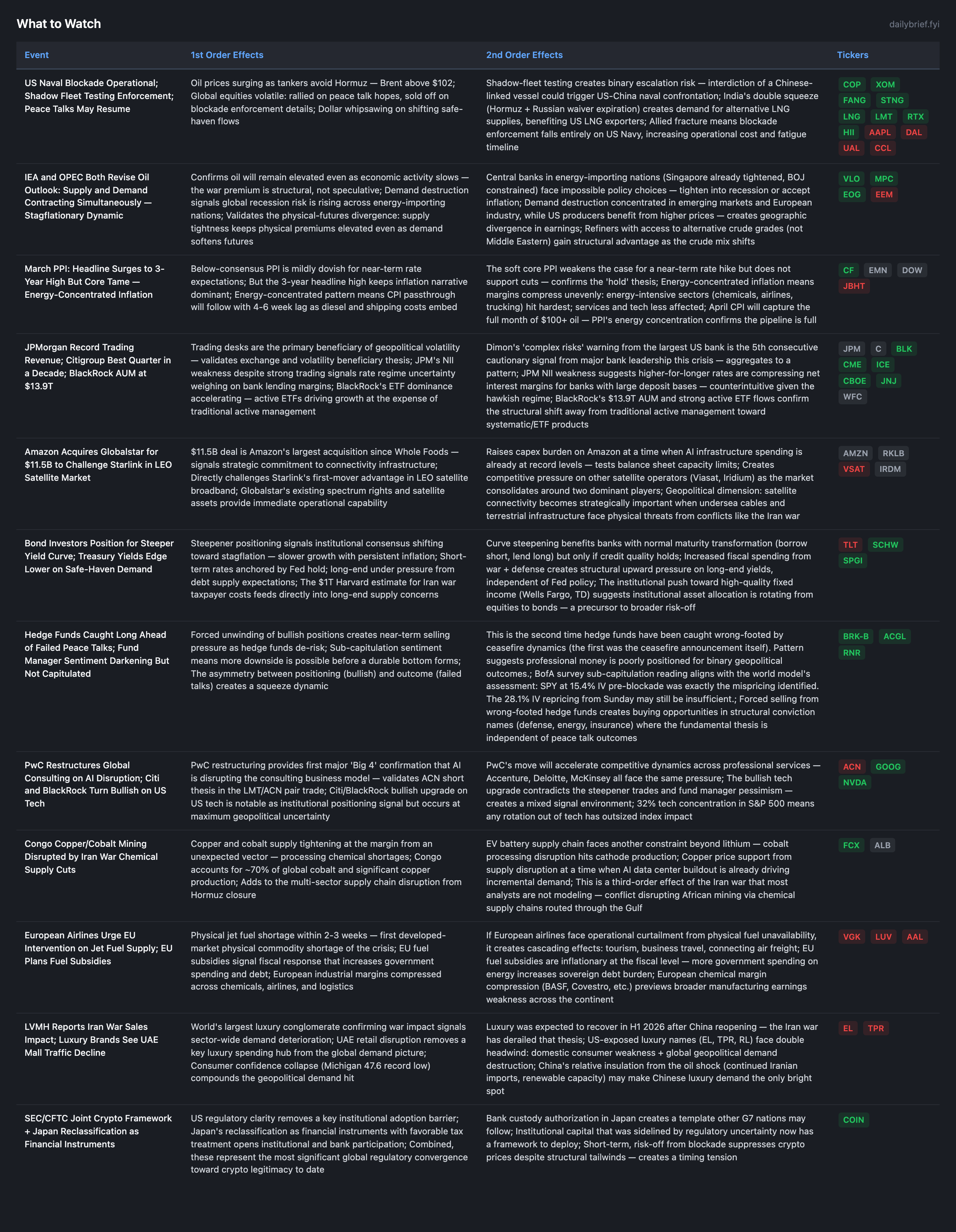
The options market is handing you a signal worth paying attention to: SPY put protection is at its cheapest point since the conflict began, with near-term IV at 12.5% — below realized volatility — while HYG’s 12.1% put skew shows institutions are positioning for a credit event on a 4-6 week timeline aligned with March 31 NAV marks. The credit cascade probability sits at 58-68%, and Goldman has confirmed hedge funds are wrong-footed long. GLD’s 0.58 OI P/C ratio shows institutional gold longs persist even as gold vol normalizes from Sunday’s extreme 49.4% to 25.6% today. The question isn’t whether the operational picture has changed — it hasn’t — but how to position for the third vol expansion cycle while protection is cheap. Full options positioning analysis, portfolio playbook, and risk scenario framework below for subscribers.
This publication is for informational and educational purposes only and does not constitute financial, investment, or trading advice. The analysis, opinions, and commentary presented here should not be interpreted as a recommendation to buy, sell, or hold any security. Always conduct your own research and consult a qualified financial advisor before making investment decisions. Past performance does not guarantee future results.
