

Two developments since Sunday’s brief materially shift the near-term distribution. First, the Pakistan talks collapse has been confirmed by the market — oil hit $111-115 on stalled negotiations — but Iran’s formal Hormuz reopening proposal remains on the table without a US counterparty. The diplomatic probability drops back to 8-10% for near-term resolution (confirming Sunday’s downgrade from 20-25%), while oil sustains its highest level of the conflict. Second, the SPY options market has completed a full round-trip from Sunday’s elevated 25.4% IV back to 11.5% contango — the 7th vol normalization cycle in 8 weeks, with each reversal confirming the pattern that protection cheapens precisely when operational risk peaks.
The new information that changes positioning: OpenAI is reportedly missing internal targets (SoftBank’s worst day in 6 months), creating the first concrete counter-signal to the $600B AI capex thesis just as Mag-7 report earnings this week. If even one major reporter guides capex UP without demonstrating revenue attribution, the gamma-concentrated bullish options positioning in these names (calls more expensive than puts in 5 of 5 reporters) creates asymmetric downside risk.
OpenAI Target Misses: First Concrete Evidence AI Monetization Timeline Is Slipping
SoftBank’s worst day in six months on reports that OpenAI missed internal performance targets represents a qualitatively different signal from prior AI skepticism. The underperformance is operational, at the single most important AI company. Combined with DeepSeek’s 75% price cut and China blocking Meta’s Manus acquisition (forcing build vs. buy timelines), the evidence base for “AI capex is growing faster than monetization” now has three independent data points from this week alone.
The investment consequence is concentrated in time: Mag-7 earnings this week. Aggregate AI capex is projected at $600B. Investors are demanding payoff evidence. Bullish call positioning means market makers are short gamma in these names — any downside surprise gets amplified by mechanical hedging. If two or more Mag-7 reporters guide capex higher without clear revenue attribution, a 5-8% tech drawdown within days is plausible.
This does NOT change the structural AI infrastructure thesis (NVDA, TSM, ASML remain BUY). Hardware layer benefits regardless of which AI model wins or whether monetization timelines slip. The demand for compute is real and validated by committed capex. What’s at risk is the premium valuations of the companies SPENDING that capex, not the companies SUPPLYING the infrastructure.
Private Capital AI-Software Lending Risk: New Channel for BX/OWL Thesis
MarketWatch reports that private equity faces greater vulnerability than private credit from AI disrupting software company business models. The mechanism: PE funds hold leveraged positions in software companies whose enterprise contracts are now being questioned by CIOs (ServiceNow impairment thesis from prior week). If revenue growth decelerates in these portfolio companies, the leverage renders them potentially insolvent.
This is a third independent risk vector for alternative managers, distinct from the real estate impairment and redemption-gating channels already tracked. Combined with the $4B distress credit fund raised by Milken family office alumni (Silver Rock Capital) explicitly targeting private capital dislocation, institutional smart money is positioning for the exact scenario the world model has been tracking.
The BX AVOID thesis now has 7+ independent bearish data points across three distinct channels: (1) real estate flagship negative returns, (2) redemption gating/liquidity stress, (3) AI-driven software portfolio impairment. Counter-signals: zero.
Iran Steel Export Suspension: Supply Tightening Beyond Energy
Iran suspended steel slab and sheet exports through end of May. Combined with the previously tracked fertilizer squeeze and circuit board supply chain disruption, the Iran conflict’s supply chain effects now extend across energy, steel, fertilizer, electronics, pharmaceuticals, and helium. Each sector disruption operates on its own timeline and creates independent inflationary pressure.
For the tracked universe, NUE and STLD benefit from tighter global steel supply, though this is a single data point and doesn’t warrant directional conviction yet. The more important implication is for the CPI model: another independent inflationary channel adds to the 20+ already tracked.
Subsea Cable Risk at Hormuz: Digital Chokepoint
Reuters (Tier 1) reports on the risk that the Iran conflict poses to critical subsea telecommunications cables passing through the Strait of Hormuz. Damage to these cables would disrupt internet and financial data connectivity between Asia and Europe.
The probability of actual cable damage is low (military operations have avoided targeting infrastructure to date), but the risk creates insurance/contingency planning demand for redundant connectivity. EQIX and data center operators with geographically diversified architecture benefit from a risk premium on alternative routing.
Oil at $111-115: Sustained Highest Level of Conflict
Brent topped $111 — three-week highs — after Pakistan cancellation confirmed and White House reiterated “red lines.” The 17% weekly surge is the largest single-week move of the conflict. S&P Global’s 700K bpd demand destruction estimate is now being overwhelmed by supply disruption intensity. Iran’s Hormuz proposal remains without a US negotiating counterparty. US Navy intercepted another sanctioned tanker in the Arabian Sea. The base case shifts further toward sustained blockade at 45-50% (up from 40-45%).
Reuters confirms the US is becoming “OPEC’s swing producer” — the first time this framing has been used by a major news service. BP profit doubling on trading revenue, Shell’s $16.4B ARC acquisition, and Phillips 66’s UK refinery expansion all represent corporate validation that $100+ oil is the operating assumption for capital allocation decisions.
Credit-Equity Divergence: 7th Cycle
HYG options have shifted back to contango (2.4% near-term) with OI P/C at 4.45 — still structurally elevated but below the 4.94 peak. The near-term normalization likely reflects mechanical expiry of event hedges around the FOMC window. The $14B junk bond outflow (FT) and Silver Rock’s $4B distress fund launch contradict the SocGen “resilience” narrative. SocGen commentary is sell-side with a 48-hour lifecycle; FT flow data and institutional fund raises are higher-tier signals. Credit cascade probability maintained at 60-70% for localized event within 4 weeks.
Consumer: 14th Consecutive Weakness Signal
UK retail sales fell by the most in 40+ years (CBI survey). US consumer sentiment at summer 2022 levels. US March retail sales “strength” (+1.7%) was a 15.5% gas station receipt spike — consumers spending more on fuel, not discretionary goods. Stripping fuel, March retail was likely flat in real terms. This extends the consumer weakness count to 14 signals without a single contradicting data point. GM’s earnings beat is a supply-side (tariff refund) story, not a consumer demand story.
European Recession: Data Confirming
German business sentiment at lowest since 2020 (Reuters, Tier 1). UK retail collapse worst in 40 years. European airlines lobbying to cut passenger perks. VGK options remain the only developed-market ETF in backwardation (19.7%, 5.0pp above HV). The three-front energy crisis (Hormuz + Baku-Ceyhan + Russia-Berlin) continues without resolution. European recession probability exceeds 65% within 6 months.
Continuing Themes
Iran conflict: 0-for-10 on diplomatic signals. Pakistan talks cancelled. Hormuz disrupted. Oil $111-115. Iran formal proposal on table without counterparty. Probability of operational change within 10 days: 8-10%.
Fed policy: Hold expected. Likely Powell’s last meeting. Warsh committee vote April 29 — procedural, not confirmation. Tillis block persists. Rates at 3.64%.
Defense: True Anomaly $650M space defense raise adds confirmation. NATO fracture at 3 signals (pattern established). Near-term thesis insulated. LMT HOLD, RTX BUY, HII BUY, NOC BUY.
Fertilizer: Reuters Tier 1 confirms “Iran war fertilizer squeeze could threaten next year’s grain harvests” — 18th bullish data point for CF/MOS thesis.
De-dollarization: 7 data points. Gold at 3-week low creates entry opportunity if structural thesis believed.
Enterprise software impairment: OpenAI target miss + DeepSeek pricing + Meta layoffs all reinforce CIO hesitation. WDAY, INTU, ACN pair trade short legs strengthened.
What to Watch
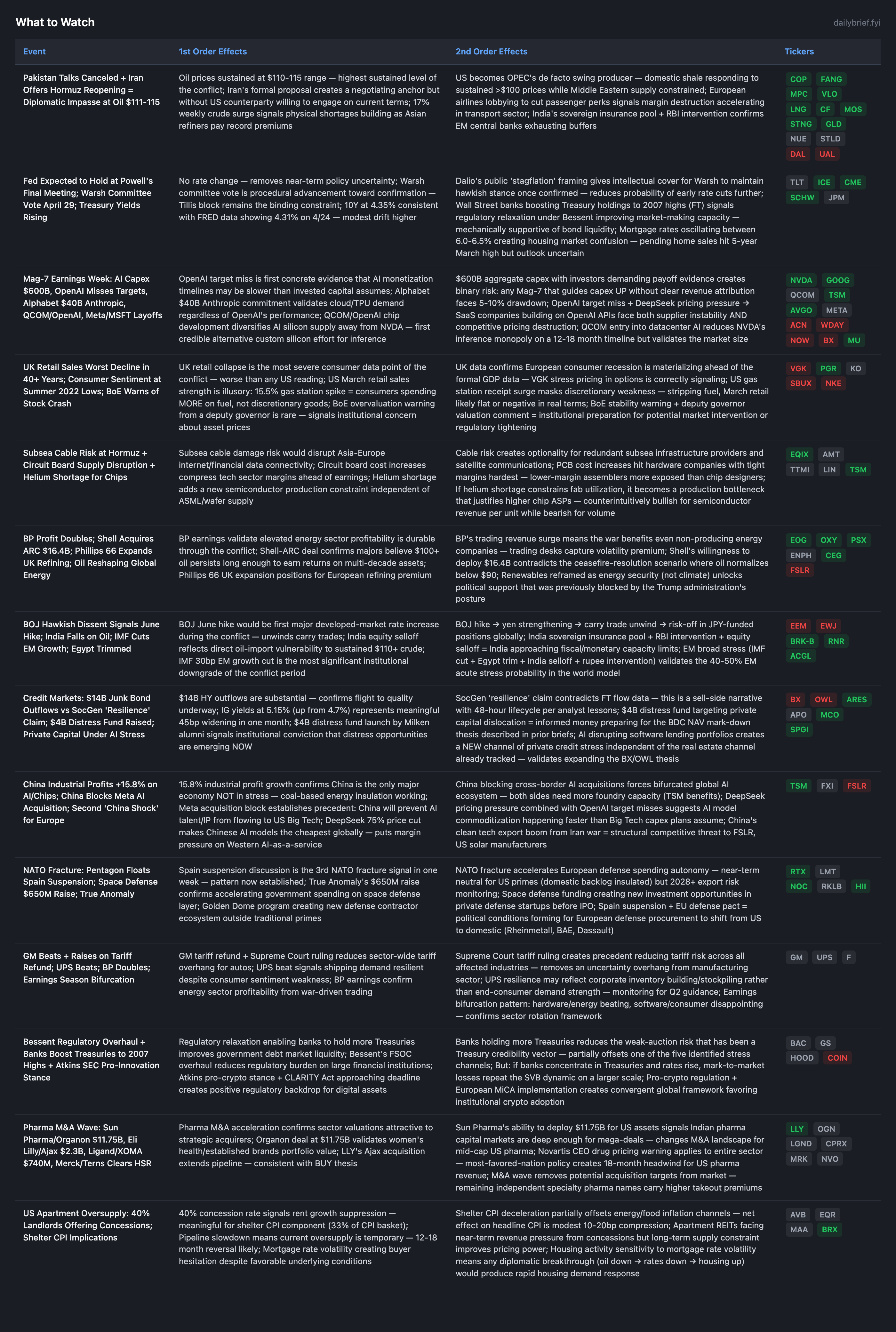
Beneath the surface calm of the 7th equity vol normalization, the options market is sending divergent signals worth dissecting. SPY implied vol at 11.5% — a full point below realized — is definitionally mispriced during active military conflict, and all six prior normalizations reversed. Meanwhile, EWJ options sit at 30.5% near-term (10.5pp above realized), making it the most stressed single-country ETF in the dataset, and EEM’s 31.2% backwardation marks the most extreme EM stress signal tracked. Gold options remain the cheapest macro asset relative to realized vol at 5.0pp below HV, creating a positioning opportunity. The premium section below breaks down exactly how to structure protection through the Mag-7 earnings window, where to add gold exposure, and the specific risk scenarios — including a 60-70% probability credit event from May BDC NAV marks — that drive portfolio allocation this week. Full options positioning analysis, portfolio playbook, and risk scenario framework below for subscribers.
This publication is for informational and educational purposes only and does not constitute financial, investment, or trading advice. The analysis, opinions, and commentary presented here should not be interpreted as a recommendation to buy, sell, or hold any security. Always conduct your own research and consult a qualified financial advisor before making investment decisions. Past performance does not guarantee future results.
