

The material shift since yesterday is in the oil/yield complex. FRED confirms the 10Y fell to 4.48% and the 30Y has retreated from its 5.2% peak as oil dropped roughly 20% from its 2026 high on reports a US-Iran framework would reopen Hormuz within a month. Yesterday’s brief declared “deal failure confirmed” as the 16th failed signal. Today the deal narrative is dominant again, with the same caveat that has held 16 times: strikes and negotiations are proceeding in parallel, and physical verification (72+ hours sustained transit) has not occurred. I am holding the energy overweight neutral-to-maintained rather than reducing, consistent with the 16x-reinforced lesson, while acknowledging the bond market is pricing meaningful de-escalation.
The genuinely new information today is at the company level. Dell’s AI-server revenue grew 757% YoY with its widest profit beat in five years, and Salesforce disappointed in the same session that Snowflake surged 35% — the cleanest single-day confirmation yet that AI infrastructure thrives while application-layer SaaS faces displacement. On the consumer side, Gap fell 14% on a guidance cut and Old Navy miss, the first earnings-level crack in the mid-market consumer that the H2 cliff thesis has been forecasting. Blue Origin’s New Glenn exploded on the pad days before an Amazon Kuiper launch, injecting fresh variance into the June 12 SpaceX IPO setup.
Core PCE confirmed at 3.3% (headline 3.8%) keeps the stagflation diagnosis intact in official data. FOMC minutes imply ~53% December hike odds while Kalshi prices 18%. The crowd is materially more skeptical of follow-through than the committee’s own minutes.
Dell +757% AI Servers and the SNOW/CRM Split: Bifurcation Confirmed at the Earnings Level
Dell’s Q1 AI-server beat is hard earnings data on enterprise AI infrastructure demand, joining Nvidia’s $150B capex commitment. The AI-demand thesis now has 10+ independent confirmations with no deceleration signal.
The more actionable development is the within-software bifurcation crystallizing in a single session. Snowflake (data infrastructure) drew an HSBC upgrade, while Salesforce (application-layer SaaS) delivered what the coverage called a “software-sector reality check” on decelerating growth. Yesterday the SNOW surge introduced this bifurcation; today the CRM disappointment confirms the other side of the divide in the same trading session. This is the cleanest validation of the GOOG vs INTU, TSM vs WDAY, and PANW vs CRM pair trades — application SaaS displacement is now an earnings-level signal (8+ data points: INTU layoffs, CRM deceleration, WDAY weakness, DeepSeek cuts), not a forecast.
Nvidia’s photonics investment flags the next infrastructure layer (energy-efficient optical data transfer) and a supply chain worth watching (COHR, LITE). I am keeping those neutral pending more than one data point.
Per calibration, IT BUY (+3.33%) is the system’s only reliable alpha source. DELL fits the archetype — hard earnings beat with a clear catalyst. TSM, MU, GOOG remain the established high-conviction positions.
Gap -14%: First Earnings-Level Crack in the Mid-Market Consumer
Gap cut sales guidance after Old Navy missed. Old Navy serves the budget-constrained shopper — exactly the cohort the world model identified as running out of buffer (401k hardship withdrawals confirmed yesterday, 3.6% savings rate, negative real wages). This is the first clean earnings-level confirmation of the H2 consumer cliff at the mass-market tier, distinct from the downtrading pattern (DLTR/KSS beats) that showed consumers moving down rather than dropping out.
The consumer picture is now bifurcated with evidence on both sides: Costco posted 9.8% comps on record gasoline volumes (defensive/value resilience), while Gap cracked at the mid-market. Costco’s gas-driven traffic is itself a stress signal — members joining specifically to save on fuel confirms household budget pressure rather than discretionary health. Two-thirds of households are cutting spending per the Conference Board. The H2 cliff probability (45-55%) is supported by this first hard earnings data point.
This strengthens the PGR vs COF and consumer-credit-deterioration positioning. Consumer Discretionary remains a BUY-prohibited sector per calibration (-2.75% across 28 calls), so the Gap and ANF signals are read as confirmations of weakness, not entry points.
New Glenn Explosion Raises Variance Into June 12 SpaceX IPO
Blue Origin’s New Glenn exploded on the launchpad during a ground test, days before it was scheduled to launch Amazon Kuiper satellites. The immediate effects: a space-sector selloff (RKLB and launch peers), a delay to Amazon’s Starlink competitor, and a reality check on launch-sector valuations.
The second-order effect matters more for portfolio positioning. Combined with the disclosure discrepancy in SpaceX’s IPO materials (Musk’s X posts contained Anthropic-deal details not in the prospectus) and $14B of inflows into SpaceX-adjacent funds, the June 12 event is now higher-variance. The forced-rotation-from-tech thesis depends on the IPO going well — capital seeking the $350B+ offering by selling existing tech. Disclosure friction and a high-profile competitor failure raise the probability of a disappointing or volatile debut, which makes the directional impact on QQQ ambiguous rather than cleanly bearish for incumbents. The semiconductor correction setup (SOX +75% YTD, record hedge fund positioning) remains intact, but June 12 as a clean forcing function is now less certain.
What to Watch
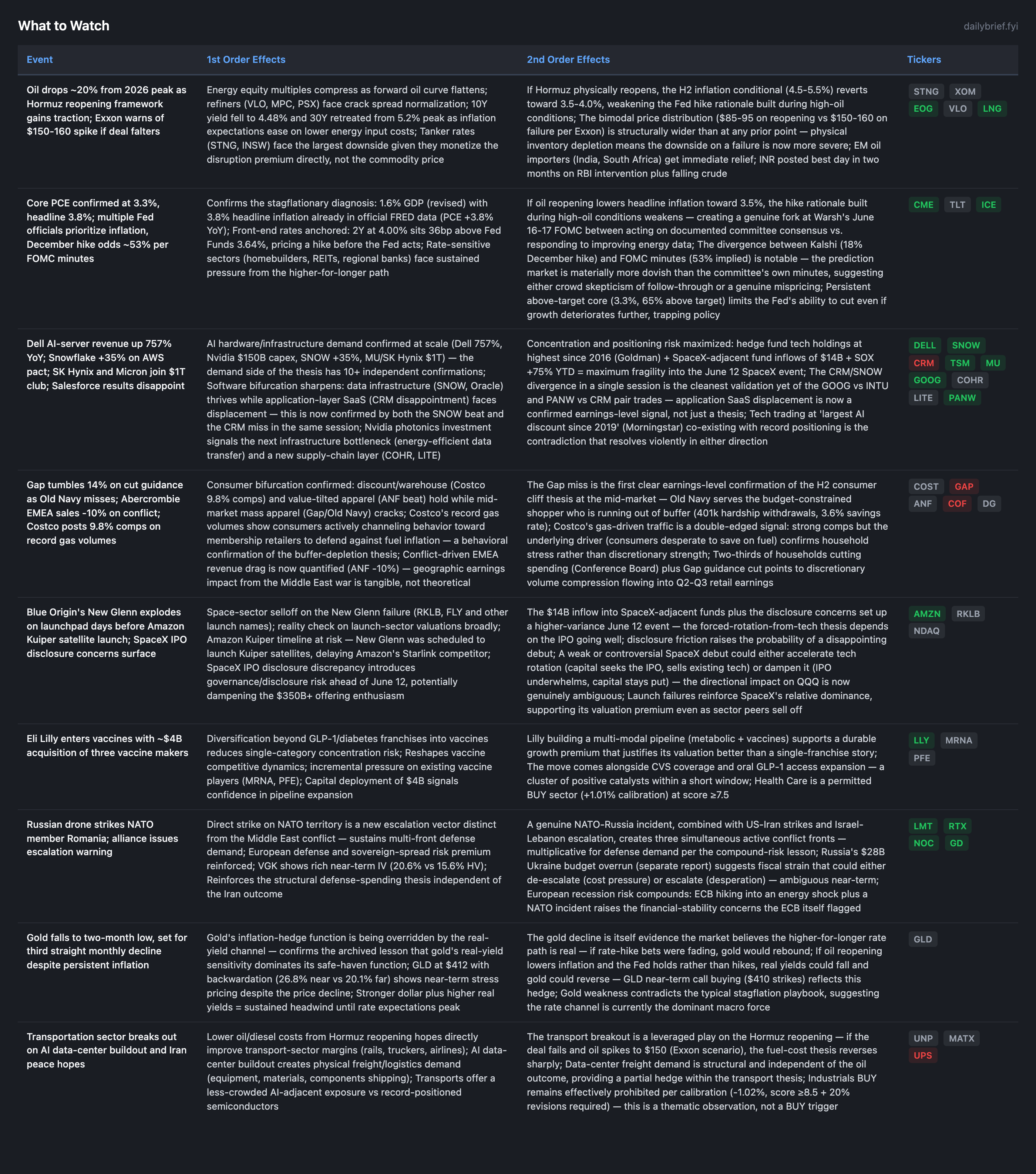
Developing Themes
Hormuz: Deal Narrative Dominant Again, Physical Verification Still Absent
Markets are weighting the Hormuz reopening framework, the counter-move to yesterday’s “16th failed signal.” The discipline here is the 16x-reinforced lesson: the deal narrative has been dominant before (May 6 one-page deal, multiple ceasefire extensions) and reversed within 48-72 hours each time. New strikes and IRGC retaliation continued through this week even as the framework gained traction. I am not reducing energy exposure; the trigger remains 72+ hours of sustained uninterrupted commercial transit.
Exxon’s Neil Chapman warning of $150-160 physical Brent if inventories hit lows and the deal fails is a meaningful data point on the downside tail. The price distribution is now structurally wider than at any prior point: $85-95 on reopening vs $150-160 on failure, because physical inventory depletion (IEA-confirmed) makes a failure more severe than earlier in the conflict. STNG and INSW are the positions most exposed to a genuine reopening since they monetize the disruption premium directly; LNG is most insulated (QatarEnergy force majeure to mid-August).
Rate Path: Minutes vs Crowd Divergence Into Warsh’s First FOMC
The inflation case stays alive, and five officials (Kashkari, Goolsbee, Cook, Jefferson, Collins) have signaled hike-readiness. Kalshi prices the December hike at 18% and the June hike at 3%, far more dovish than the committee’s own minutes — suggesting either crowd skepticism that the committee follows through, or a view that the oil reopening will lower inflation enough to stay the Fed’s hand. If oil reopening pulls headline inflation toward 3.5%, Warsh faces a real fork at June 16-17 between acting on consensus built during high-oil conditions and responding to improving energy data. The 2Y at 4.00% sits 36bp above Fed Funds, still pricing a hike before the Fed acts.
Credit Markets: Contango Persists, Access Open
HYG remains in contango (near-term 5.2% < 12-month 8.3%) with OI P/C at 3.82. The structural signal — sophisticated capital pricing credit stress arriving in 6-12 months while near-term stays calm — is intact across multiple sessions. The WSJ “priced to perfection” framing and the private-credit spread divergence (smaller lenders priced wider) are consistent with the cascade timeline of H2 2026 - H1 2027. Primary access remains open ($18B single-day issuance prior). No action; the cascade is not imminent.
Continuing Themes
Defense: Romania drone strike adds a third active front (Middle East + NATO/Russia + Israel-Lebanon). Multi-vector demand structurally confirmed. LMT, RTX, NOC, GD overweight maintained.
Small-cap: IWM OI P/C at 2.02, July 2 $260 put thesis intact. Bears building the largest Russell 2000 short despite the 40% one-year rally. Continue to avoid.
Semiconductor correction: SOX +75% YTD, record positioning. June 12 SpaceX now higher-variance per New Glenn failure. 40-50% correction probability within 2-4 weeks maintained.
CF Industries: China urea export resumption confirmed (this week’s reporting). Two of three headwinds persist. Maintain 5.5/10 downgrade; do not rebuild.
Gold: Third straight monthly decline despite inflation confirms the real-yield channel dominates the safe-haven function. No thesis change.
The vol picture tells its own story: SPY near-term IV has compressed to 11.2% — essentially at the 11.8% HV — fully unwinding the 24.6% geopolitical premium that spiked over Memorial Day weekend, even as strikes continue. The risk is now concentrated in EM (47.6% near-term IV vs 19.9% HV, the most stressed complex), small-caps (structural 2.02 OI P/C despite normalized IV), and the H2 credit window (HYG contango with -6.9% 12-month put skew). The single most specific directional bet is the TLT June 18 call concentration — a dovish-Warsh surprise that sits directly against five officials emphasizing inflation. The premium section maps how to position energy through the bimodal $85-95 vs $150-160 distribution, where the validated software pair trades sit, and frames six discrete risk scenarios with probabilities from the 30-40% deal-failure tail to the 45-55% consumer cliff.
Full options positioning analysis, portfolio playbook, and risk scenario framework below for subscribers.
This publication is for informational and educational purposes only and does not constitute financial, investment, or trading advice. The analysis, opinions, and commentary presented here should not be interpreted as a recommendation to buy, sell, or hold any security. Always conduct your own research and consult a qualified financial advisor before making investment decisions. Past performance does not guarantee future results.
