

The signal that matters most today is the Broadcom miss: a disappointing AI chip revenue forecast sent AVGO down ~15% (~$300B of value destroyed) and dragged Micron, Marvell, Intel, CrowdStrike, and Ciena lower, with SoftBank down 11%. This is the first hard-earnings deceleration data point in the AI-infrastructure complex after 12+ consecutive confirmations, and it is the catalyst the semiconductor-correction setup (40-50% within 2-4 weeks) had been waiting for. The honest read is more nuanced than the tape: HPE posted strong AI-server results the same day and Alphabet committed $80B to its buildout, so the deceleration may be specific to Broadcom’s custom-ASIC franchise and customer concentration rather than proof of broad AI-capex softening. One counter-signal against 12+ confirmations does not flip the thesis; it shifts the analytical burden toward watching whether the next prints confirm or isolate it. However, confirming or disconfirming demand at the margin is not a reason to chase the merchant-GPU names lower or add to integrators.
Two other developments are genuinely new. Private-credit redemption gating spread to Blackstone’s flagship fund ($4.5B in requests) and Partners Group’s US wealth fund, the third and fourth named managers to gate after Cliffwater, hardening the liability-side-precedes-asset-side sequence that the HYG contango has been pricing for H2 2026-H1 2027. And SpaceX set its record IPO at $135/share, ~$86B raise, $1.78T valuation for June 12, which removes some variance versus the New Glenn overhang but leaves a wide gap to Morningstar’s sub-$875B fair value. The rate picture is unchanged in substance: strong labor (JOLTS 7.6M, ADP 122K), Logan calling policy “a bit loose” against Williams’ “right place,” and the minutes-vs-Kalshi December-hike gap (53% vs 35%) narrowing but persisting into Warsh’s June 16-17 FOMC. Do not pre-position; Kalshi prices a June hike at 2%, so the binary is about December and the meeting’s guidance tone.
Broadcom Miss: First AI-Infrastructure Deceleration Signal, but Possibly Idiosyncratic
AVGO missed Q2 revenue and cut its AI chip revenue forecast (FT, CNBC, Tier 2). This is hard earnings data, not commentary, and it is the first genuine counter-signal in the AI-infrastructure series the world model has tracked at 12+ confirmations with zero deceleration.
The causal question is whether this is timing/customer-specific or broad. Two facts argue for the narrow read. First, end-demand for AI infrastructure is not visibly rolling over, given the same-week HPE and Alphabet data points. Second, Broadcom’s AI revenue is concentrated in custom ASICs for a small number of hyperscalers, where order timing is lumpy and a single customer’s digestion cycle can swing a quarter. The cross-read to NVDA’s merchant-GPU demand is therefore weak; NVDA selling off in sympathy is positioning-driven, not a fundamental readthrough. The miss is not a reason to short the complex, and the sympathy drops in CRWD (no AI-chip exposure) are de-grossing noise.
What it does do is supply the catalyst the semiconductor-correction setup needed. SOX is up ~75% YTD into record hedge-fund tech positioning, and the dispersion trade (rising single-stock vol under calm index vol, flagged in today’s MarketWatch piece) means one bellwether miss propagates to the index. The correction probability is now better supported. The clean expressions stay what they were: TSM (BUY 7.4, diversified across the entire AI-silicon complex so insulated from one customer’s cut), MU (HOLD 6.1, where this is the specific risk to peak-cycle DRAM/HBM ASPs), and the GOOG/MSFT cloud layer. AVGO itself is neutral pending the next data point on whether the cut is timing or structural.
Private-Credit Gating Spreads to Blackstone’s Flagship and Partners Group’s US Fund
Two FT reports (Tier 2): Blackstone capped withdrawals from its flagship private credit fund after redemption requests hit $4.5B in Q2, and Partners Group is preparing to cap its US fund for wealthy individuals. This makes three to four named managers gating (after Cliffwater’s $31B fund at 17% requests and Partners Group’s earlier $8.6B PE vehicle), a 4+ data-point pattern.
This is the liability-side stress (redemptions, gating) that canonically precedes asset-side stress (defaults, NAV markdowns, spread widening). The sequencing is exactly what the HYG curve prices, with stress placed 6-12 months out rather than now. IG primary access stays wide open ($18B single-day issuance prior, May the busiest in six years), so the cascade-via-primary-closure pathway remains dormant; only the HYG-contango/redemption pathway is live. The reflexivity risk to watch is forced asset sales to meet even capped redemptions marking down loan books and pulling asset-side stress forward.
This reinforces the permanent-capital premium. BX’s own flagship gating is a direct hit to the redemption-exposed short legs (BX in APO-vs-BX, OWL in ARES-vs-OWL). One nuance cutting the other way: Nippon Life signed a $9.4B MOU into Blackstone private credit the same week, so sticky institutional capital is still flowing in even as retail/HNW gates. The bifurcation between sticky institutional and flighty wealth capital is the thing to track. I hold BX/OWL bearish-lean and APO/ARES bullish-lean, with the calibration caveat that APO at a 7.55 score lost 16.9% historically, so conviction is moderate and these are pair expressions, not outright longs.
SpaceX Prices Record IPO at $1.78T for June 12
SpaceX set its IPO terms (Reuters/FT/CNBC, Tier 1-2), which would be the largest Wall Street debut ever. Confirmed pricing removes some of the variance the New Glenn pad explosion and disclosure-discrepancy created, but the Morningstar fair-value gap sets up post-IPO mark-down risk.
The mechanism that matters: $86B SpaceX, plus Anthropic’s filing and Quantinuum’s $1.68B raise, competes for the same capital pool at a moment of record tech positioning and a fresh AVGO de-rating. A strong debut validates risk appetite and could re-accelerate the rotation into mega-tech; a weak one in a post-AVGO tape accelerates the rotation out that Larry McDonald and the dispersion trade flag. QQQ direction around June 12 is genuinely ambiguous; treat it as a variance event. QQQ near-term IV is rich at 22.1% (vs 15.9% HV) in flat term structure with a 30.9% one-week put skew, the acute event-hedging consistent with that read. SATS rallies as a ~3% SpaceX-stake proxy, which is event speculation, not a change to its AVOID thesis on Starlink/Starshield terrestrial-broadband disruption.
What to Watch
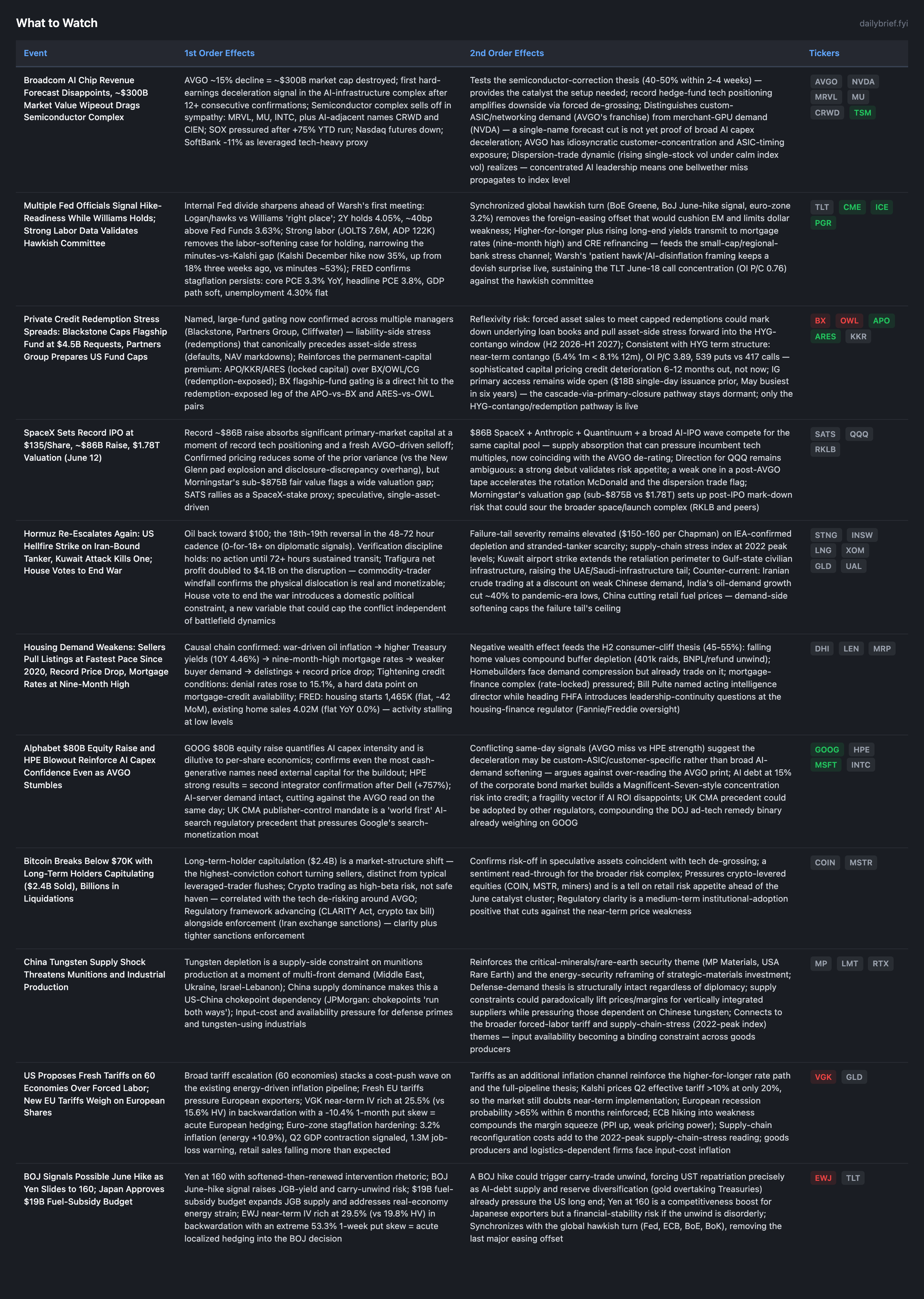
Developing Themes
Rates: Strong Labor Validates the Hawks, Williams Holds, Two-Sided Into Warsh
Logan called policy “a bit loose” and multiple officials signaled hike-readiness if the war drives persistent inflation, while Williams said policy is in the “right place.” The labor data removed the labor-softening case; the 2Y holds 4.05%, ~40bp above Fed Funds. The December-hike gap is narrowing toward the committee as the data validates it (up from 18% three weeks ago). The binary is entirely about December and the tone of forward guidance at the June 16-17 meeting. The TLT June-18 call concentration (OI P/C 0.76, near-term IV in backwardation) is the dovish-Warsh bet, now fighting both strong labor and a full inflation pipeline; Warsh’s “patient hawk”/AI-disinflation framing keeps it live. Do not pre-position; let exchanges (CME, ICE) carry the vol.
Hormuz: 18th-19th Reversal, Trafigura Confirms the Dislocation, House Votes to End the War
Multiple Tier 1 Reuters reports confirm the US Hellfire strike on an Iran-bound tanker, the Kuwait airport attack, and the IRGC strike on the Fifth Fleet HQ; oil is back toward $100 (Brent +37% since the conflict began). Trafigura’s net profit doubled to $4.1B on the disruption, a hard confirmation that the physical dislocation is real and monetizable. The cadence is unchanged (48-72 hour flips, 0-for-18+ on diplomatic signals); verification discipline holds, no action until 72+ hours sustained transit. The new variable is the Republican-led House voting to block continued war, a domestic political constraint that could cap the conflict independent of the battlefield. The failure-tail severity stays elevated ($150-160, Chapman) on depletion and stranded-tanker scarcity, but the ceiling is capped by demand-side softening: Iranian crude at a discount on weak Chinese demand, India’s oil-demand growth cut ~40% to pandemic-era lows, China cutting retail fuel prices. Hold STNG/INSW and LNG (insulated via QatarEnergy force majeure to mid-August); do not reduce. Energy BUYs are -1.58% across 142 calls per calibration, so these stay HOLDs, not adds.
AI Capex Financed at Macro Scale; UK CMA Sets an AI-Search Precedent
Alphabet’s $80B equity raise quantifies the capex intensity and is dilutive; AI-related debt is now ~15% of the corporate bond market, building Magnificent-Seven-style concentration risk into credit and a fragility vector if ROI disappoints. The UK CMA forced Google to let publishers block their content from powering AI search summaries, a world-first precedent that could be adopted elsewhere and compounds the DOJ ad-tech remedy binary. I maintain GOOG bullish (4+ data points: Search +19%, Cloud +63%, Berkshire’s $10B add), not raising it, because the raise tempers per-share economics and the CMA mandate adds regulatory friction. HPE stays theme-confirming and conviction-neutral as a margin-dilutive integrator that ran on its print.
Housing Demand Weakens as the Rate Chain Bites
Sellers are delisting at the fastest pace since 2020 (Redfin), home values posted their biggest drop in nearly a decade, the popular mortgage rate hit a nine-month high, and loan-application denial rates rose to 15.1% (from 12.2% in 2021). The causal chain is clean: war-driven oil inflation → 10Y at 4.46% → nine-month-high mortgage rates → weaker demand → delistings and price drops. FRED shows starts flat at 1,465K and existing sales flat at 4.02M, activity stalling at low levels. The negative wealth effect compounds the H2 consumer-cliff thesis (45-55%) on top of 401k raids and BNPL/refund unwind. Homebuilders (DHI, LEN) trade on this already and Consumer Discretionary is BUY-prohibited; read misses as confirmation, not entry. MRP’s ~72% Lennar concentration is the specific land-bank exposure to watch.
Continuing Themes
Small-cap: IWM OI P/C at 2.16 (highest among US-equity ETFs) with near-term IV normalized to 20.7% (fair vs 19.1% HV). Structural put dominance intact; July 2 $260 put thesis live. Continue to avoid.
Defense: Tungsten supply shock (China-dominated) is a production-input constraint against structurally confirmed multi-front demand; overweight maintained (RTX, NOC, GD, LMT, MSI). Reinforces the critical-minerals theme (MP, USA Rare Earth) as a watch item.
Gold: GLD down ~10% despite active conflict confirms the real-yield channel dominates the safe-haven function; near-term IV cheap at 23.5% (vs 26.8% HV). No thesis change.
Japan/yen: Yen at 160, BOJ June-hike signal, $19B fuel-subsidy budget; EWJ 1-week put skew an extreme 53.3% in backwardation. Carry-unwind/UST-repatriation risk intact.
Europe: Fresh EU tariffs + euro-zone inflation 3.2% + Q2 contraction signal + 1.3M job-loss warning; VGK near-term IV rich at 25.5% in backwardation. European recession probability >65% within 6 months; bearish lean on the region.
Crypto: Bitcoin below $70K with long-term-holder capitulation ($2.4B) and billions in liquidations; trading as high-beta risk, not a haven. CLARITY Act and crypto tax bill advancing (medium-term positive) against near-term price weakness. No portfolio-relevant change.
CF Industries: No new data point; tactical HOLD (6.0). Clean exit if Hormuz physically reopens.
Consumer: Macy’s/Ulta beats are execution and higher-tier resilience, diverging from but not contradicting the Gap/Old Navy mid-market crack and FT’s CPG-weakness signal. Express via PGR over COF; Consumer Discretionary BUY-prohibited.
The options tape tells a sharper story than the calm index front end suggests: SPY near-term IV at 13.9% has unwound its geopolitical premium even with oil back toward $100, while EEM remains the most stressed complex at 40.3% near-term IV (+20.3pp over HV) with a 28.0% one-week put skew pricing the Hormuz binary plus the dollar-cushion removal. QQQ’s front end has re-firmed to 22.1% with a 30.9% one-week put skew into the AVGO aftermath and the June 12 SpaceX variance event, even as longer-dated positioning stays constructive. The HYG structure — flat term, HY spread tight at 2.71% — confirms credit stress is priced into H2 2026-H1 2027 rather than now, exactly the window the named private-credit gating corroborates. Below, the full options positioning analysis, the pair-trade portfolio playbook, and the eight-scenario risk framework lay out how to position around the AVGO sequence, hedge the June FOMC and SpaceX catalysts, and identify which signal flips the AI-infrastructure thesis.
Full options positioning analysis, portfolio playbook, and risk scenario framework below for subscribers.
This publication is for informational and educational purposes only and does not constitute financial, investment, or trading advice. The analysis, opinions, and commentary presented here should not be interpreted as a recommendation to buy, sell, or hold any security. Always conduct your own research and consult a qualified financial advisor before making investment decisions. Past performance does not guarantee future results.
