

The macro landscape is largely unchanged from yesterday’s brief; the data confirms rather than redirects. What is genuinely new today is the crystallization of the AI IPO and financing wave: OpenAI confidentially filed, SpaceX filed for a $1.78T listing, WSJ reported US officials are discussing government equity stakes in AI companies, and FT reported Apollo and Blackstone arranged a $35bn private-credit financing for Anthropic’s chips. Taken together, this is the structural development of the day: it confirms AI remains the dominant capital-markets theme (supporting the idiosyncratic read of the Broadcom miss), connects the AI buildout directly to the private-credit channel the model has been watching, and front-loads a heavy equity-supply calendar into a record-positioned tape.
The second shift is in the Hormuz distribution rather than the daily tape. CNBC reports traders now price a meaningful probability that the strait does not normalize until 2027, versus a ~60% chance of reopening before August just two weeks ago. The transit-fee framework is hardening as the middle outcome. The oil tape itself remains the same range-bound noise (strike pause, near-deal claims, continuing strikes) that the 0-for-20 verification discipline has correctly discounted twenty times. The rate picture also hardened on schedule: Goldman dropped its 2026 cut call after the 172K payrolls print, the 10Y sits at 4.55% (FRED), and markets now price the ECB’s first hike in three years. The crowd-vs-committee December-hike gap has fully closed, which strands the dovish-Warsh TLT bet without an informational edge into the June 16-17 FOMC.
The AI IPO and Financing Wave Crystallizes
Three filings landed in close proximity: OpenAI confidentially (NYT, Yahoo, Tier 2-3), SpaceX for $1.78T (FT, Tier 2), and Anthropic’s $35bn private-credit financing arranged by Apollo and Blackstone (FT, Tier 2). Separately, WSJ (Tier 2) reported US officials discussed taking financial stakes in the AI industry, including conversations with Sam Altman.
The evidentiary weight here is strong: multiple Tier 1-2 sources, hard filings rather than commentary. Three implications follow. First, this confirms AI is still the dominant capital-markets theme despite Broadcom, which supports the idiosyncratic read of that miss: a sector genuinely decelerating does not see its two largest private labs and a $1.78T space-compute play rush to market simultaneously. Second, the Apollo/Blackstone chip financing for Anthropic is the cleanest link yet between Arc 1 (AI-capex) and Arc 2 (credit cascade). It is GPU-collateralized lending to a pre-profit lab, embedding rapid hardware obsolescence into private-credit books precisely at the managers whose liability sides are gating (Blackstone’s flagship) and selling stakes ($2bn secondary). If AI ROI disappoints, the impairment now hits credit marks, not only equity multiples. Third, the heavy equity-supply calendar ($86bn from SpaceX alone) drains secondary liquidity into a record-positioned tape, historically a late-cycle forward indicator.
The government-equity-stake talks are the most novel and least-priced element. A single WSJ report is a data point, not a trend, so I treat this as a hypothesis to monitor rather than a position. If it advances, it reframes AI compute and power (CEG, VST, GEV) as quasi-strategic assets with a potential political backstop but also antitrust and control entanglement. The mechanism to watch is whether government involvement extends from labs to the compute/power layer.
This does not change the AI-infrastructure positioning. The clean expressions stay TSM, MSFT, GOOG; integrators stay conviction-neutral; IT BUY remains the only reliable alpha source per calibration at score ≥8.0 with confirmed catalyst. The financing wave confirms the theme’s vitality but is not a new entry signal.
Biotech M&A Reaches Critical Mass
Three deals in one week: GSK/Nuvalent at $10.6bn (Nuvalent +39%), Incyte/Vega at $1.25bn, and Standard BioTools/Treeline. CNBC frames this as patent-cliff-driven pipeline rebuilding. Three independent deals constitute a pattern worth building on per the evidentiary standard. The Nuvalent +39% premium signals large-cap pharma will pay up for de-risked clinical oncology assets, which re-rates mid-cap comps and gives the healthcare bid a fundamental underpinning distinct from the positioning-driven de-grossing of crowded AI that drove the Dow’s 875-point healthcare-led surge. The durable component of the healthcare bid is the M&A demand; the rotation component is transient. This supports incumbents with deal-capacity balance sheets (LLY) and differentiated mid-cap takeout candidates (NBIX), though I am keeping the M&A read as supportive context rather than the thesis driver for either name.
What to Watch
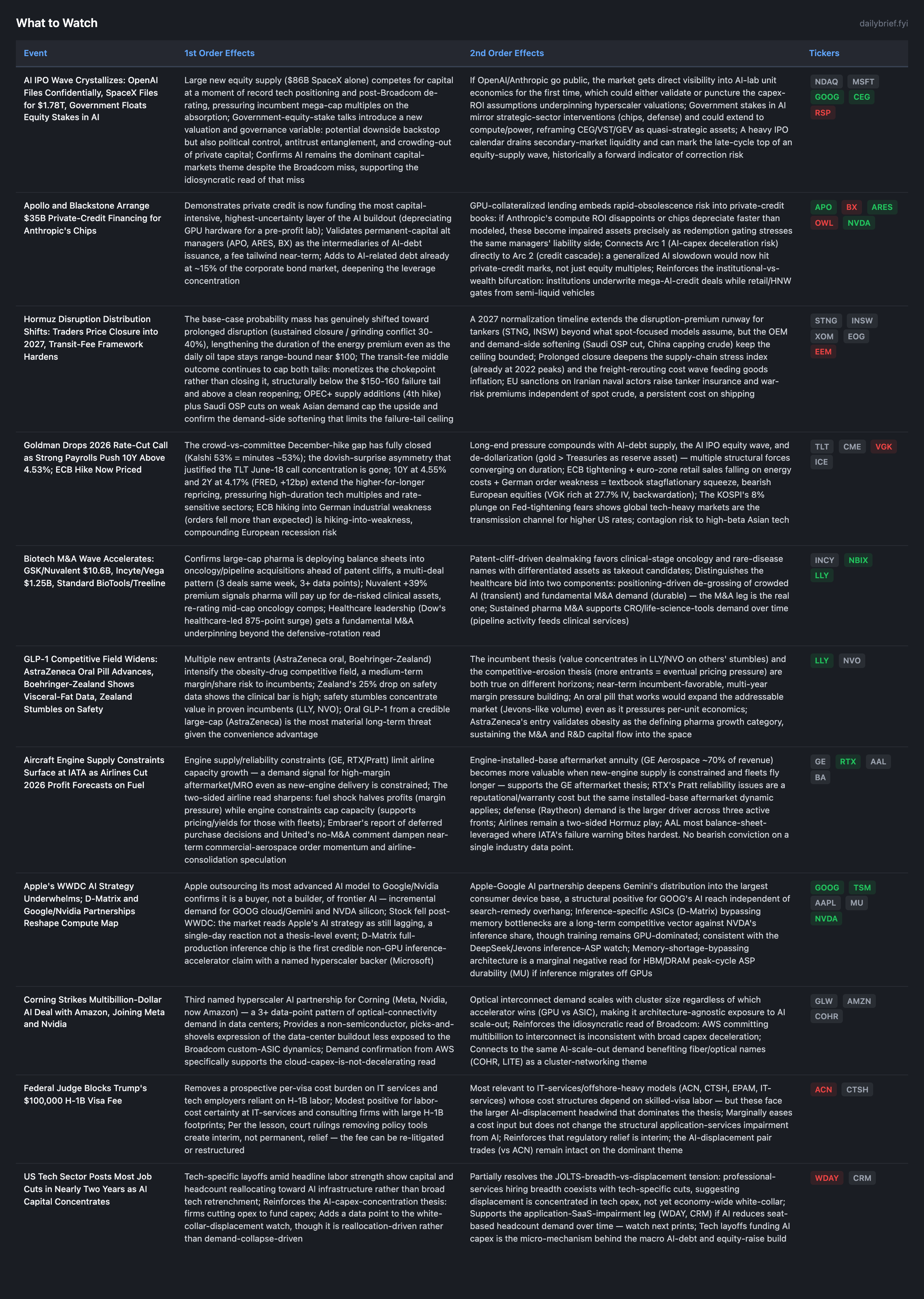
Developing Themes
Hormuz: Distribution Shifts Toward Prolonged Disruption
The new information is the probability mass: traders now price normalization possibly not until 2027, versus ~60% reopening-before-August two weeks ago (CNBC). This lengthens the disruption-premium runway for tankers (STNG, INSW) beyond spot-focused models, while OPEC+’s fourth quota hike and Saudi’s July OSP cut to Asia on weak demand cap the upside and confirm the demand-side softening that limits the $150-160 failure-tail ceiling. The transit-fee framework continues to harden as the structurally-mispriced middle outcome. The verification discipline is unchanged: a strike pause and near-deal claims were followed by continuing strikes, so the 0-for-20 record holds and no position changes until 72+ hours of sustained transit. Energy stays overweight, HOLD, no add (energy BUYs -1.58% across 142 calls per calibration).
Rates: The Crowd-Committee Gap Closes, ECB Hike Priced
The 2Y is at 4.17% (FRED, rising). The dovish-surprise asymmetry that justified the TLT June-18 call concentration is gone, and that bet now fights the data with no edge. The new cross-asset element is markets pricing the ECB’s first hike in nearly three years, hiking into German industrial-order weakness and falling euro-zone retail sales, a textbook stagflationary squeeze that reinforces the bearish-Europe lean (VGK rich at 27.7% IV in backwardation). Williams (”right place”) and Taylor (on hold) against Goldman’s hawkish revision keep the June 16-17 guidance tone two-sided; do not pre-position. The KOSPI’s 8% plunge on Fed-tightening fears, amplified by retail leveraged products (a 16% 24-hour swing), shows tech-heavy Asian markets are the transmission channel for higher US rates.
AI Compute Map: Apple as Buyer, Inference-ASIC Competition Surfaces
Apple’s WWDC confirmed it is a buyer of frontier AI, partnering with Google and Nvidia for its most advanced model; the stock fell on the announcement, a single-day reaction. The Apple-Google partnership extends Gemini into the iOS base, a structural positive for GOOG’s AI distribution independent of the search-remedy overhang. Microsoft-backed D-Matrix entered full production of an inference chip claiming 10x GPU performance while bypassing memory shortages, the first credible named-hyperscaler-backed non-GPU inference accelerator. This is a long-term share-vector watch against NVDA’s inference dominance (training stays GPU-bound) and a marginal negative for peak-cycle HBM/DRAM ASP durability (MU) if inference migrates off GPUs, consistent with the DeepSeek/Jevons inference-ASP watch. It reinforces the diversified-silicon expression (TSM fabricates across architectures). Corning’s multibillion AWS deal, its third named hyperscaler AI partnership after Meta and Nvidia, adds architecture-agnostic, picks-and-shovels confirmation that cloud capex is not decelerating.
Tech Layoffs Partially Resolve the JOLTS-Displacement Tension
US tech posted its most monthly job cuts in nearly two years (Bloomberg) against a 172K headline and 7.6M JOLTS openings, attributed to reallocation toward AI capex. This partially resolves the professional-services-breadth-vs-displacement tension the model has carried: displacement appears concentrated in tech opex (firms cutting headcount to fund capex), not yet economy-wide white-collar. It is a marginal negative for seat-based application SaaS (WDAY, CRM) over time. Watch the next WDAY/CRM prints; do not let the pair trades run on the assumption.
Continuing Themes
Private credit: Liability-side gating plus the Blackstone $2bn secondary sale continue; the Anthropic deal (above) adds the asset-side AI-credit origination angle. HY spread tight at 2.76% (FRED), no conversion. Watch the first HYG move off that level.
Small-cap: IWM OI P/C at 2.28, structural put dominance intact despite near-term IV at 26.6%. July 2 $260 put thesis live. Continue to avoid.
Defense: Multi-front demand confirmed; Airbus’s German-led sixth-gen fighter program adds a European-spending data point. Overweight maintained (RTX, NOC, GD, LMT, LHX).
Software bifurcation: Pair trades CORE (GOOG vs INTU, TSM vs WDAY, PANW vs CRM). H-1B fee block (below) is interim cost relief for IT-services, not a thesis change.
GLP-1/obesity: AstraZeneca’s oral pill and Boehringer-Zealand data widen the field; Zealand’s 25% safety drop concentrates near-term value in incumbents (LLY, NVO). Multi-year competitive erosion building against near-term incumbent favorability.
Airlines: IATA fuel-shock profit cut plus newly-surfaced GE/RTX engine-supply constraints; two-sided Hormuz play, AAL most leveraged. Monitor, no conviction.
Consumer: Campbell’s flagged tightening spending and the NY Fed survey shows household financial worries at the worst since mid-2022, reinforcing the H2 cliff. Express via PGR over COF.
Gold: Citi’s 20%-by-September call and steady price action confirm the real-yield channel dominates; GLD near-term IV fair at 26.5%. No thesis change. H-1B fee block: interim relief per the court-rulings lesson, not permanent.
The options tape is sending one extreme signal worth acting on and several worth discounting. EEM near-term IV has spiked to 50.8% against 21.3% HV — the most stressed reading in the set — with steep backwardation and a 16.2% one-week put skew that reads as binary and real, not event-hedging noise. Meanwhile TLT’s call-heavy 0.80 OI P/C keeps the dovish-Warsh June-18 bet alive in positioning even as it now fights the data with no informational edge, and HYG sits complacent at 2.76% spreads with the credit stress priced out to H2 2026. The premium section maps how to position the durable signals against the discountable front-end noise, where to hold the AI-credit pair trades now that the Anthropic deal makes the linkage live, and which of eight risk scenarios — from a late-cycle IPO top to a disorderly rupee move — most warrants a hedge.
Full options positioning analysis, portfolio playbook, and risk scenario framework below for subscribers.
This publication is for informational and educational purposes only and does not constitute financial, investment, or trading advice. The analysis, opinions, and commentary presented here should not be interpreted as a recommendation to buy, sell, or hold any security. Always conduct your own research and consult a qualified financial advisor before making investment decisions. Past performance does not guarantee future results.
