

Since the May 4 brief, three developments have materialized that shift probabilities: (1) The 30-year Treasury yield breached 5% — the Hartnett “Maginot Line” arrived earlier than the “late summer” base case, driven by Iran’s direct attack on UAE’s Fujairah petroleum complex. (2) HSBC disclosed a $400M loss transmitted through Apollo’s private credit lending, providing the first concrete evidence of bank-private credit contagion that our model identified as a 75-85% probability event. (3) Amazon’s launch of supply chain services to third parties produced immediate -9% to -10% repricing in UPS/FedEx, creating a new structural competitive threat in logistics.
The vol regime change identified on May 4 is persisting rather than reverting to the April 27 pattern. SPY near-term IV has moderated slightly from 19.6% to 15.0% but remains in backwardation at the 1-week tenor (+2.6pp vs HV), and IWM (25.2%, +5.9pp) and VGK (24.5%, +9.6pp) remain in acute stress pricing. The naval confrontation and Fujairah infrastructure attack represent a qualitative escalation that sustains the vol premium.
30-Year Treasury at 5%: The Threshold Arrived Early
The 30-year yield topped 5% on May 4-5, triggered by Iran’s drone attack on Fujairah — weeks earlier than the “late summer” estimate in the world model. UK 30-year gilts simultaneously hit 28-year highs, confirming this is a coordinated global long-duration selloff driven by inflation expectations, not idiosyncratic US fiscal concerns.
The mechanism: $114-125 Brent + pipeline CPI passthrough + FOMC paralysis (Kashkari explicitly stated the Iran war prevents forward guidance) = repricing of the terminal rate. Bond traders who were hedging for 5% per Bloomberg’s earlier reporting are now through the line.
What this means operationally:
CRE refinancing: $875B in 2026 maturities now face rates roughly double origination. The 12.07% CMBS distress rate (already an all-time high) will accelerate.
Mortgages: 30-year fixed approaches 7.5%, which contradicts the earlier MarketWatch piece noting “lowest mortgage rates in three spring seasons.” Housing recovery is dead on arrival.
ERP: Trailing ERP was -92bps with 30Y at 4.7%. At 5%, it deepens to approximately -125bps — further into territory with no benign historical resolution.
The TLT term structure has shifted meaningfully: 12-month IV at 15.3% vs near-term 11.8% creates contango, but that 15.3% is 50% above the 10.2% HV. The market expects bond volatility to increase over the next year. This is correct if Warsh eliminates forward guidance as signaled.
HSBC/Apollo: The Bank-Private-Credit Transmission Channel Is Now Proven
HSBC’s $400M fraud-related loss through Apollo lending to collapsed mortgage lender MFS proves the mechanism. The world model identified $300B in bank credit facilities to private credit funds (Goldman $118B alone) as the contagion channel. HSBC demonstrated that losses transmit through exactly this pathway.
The precedent matters more than the size. If one bank has $400M in losses from one lending relationship, the aggregate exposure across $300B in facilities contains multiples of this. Other banks now face analyst questions about their own private credit facility exposure quality. This accelerates the tightening dynamic: banks pulling back → private credit funds face liquidity pressure → forced asset sales → NAV declines → more redemption requests → more bank pullback.
BDC NAV marks due this week (May 5-11) now arrive in the context of a proven contagion mechanism. The credit cascade probability holds at 75-85%, with localized event probability within 3 weeks at 55-65%.
Amazon Supply Chain Services: Structural Logistics Disruption
Amazon opening its freight, distribution, fulfillment, and parcel infrastructure to all businesses is a permanent competitive re-rating for UPS (-10%) and FedEx (-9%). This converts Amazon’s $100B+ logistics investment from a cost center supporting its marketplace into a revenue-generating platform competing on price with incumbents who have higher cost structures.
The market reaction (-9% to -10% in a single session) reflects a structural thesis change. Amazon has lower marginal costs because its network was built for its own volume; incremental third-party volume is nearly pure margin. UPS and FedEx must either cut prices (compressing margins on their entire existing business) or cede volume.
For portfolio positioning: this reinforces the AVOID on consumer discretionary/logistics (UPS, FDX) and is neutral-to-positive for AMZN, though the stock already reflects considerable optionality. Third-party logistics names (XPO, JBHT, ODFL) face secondary effects but are more insulated in LTL/specialized freight.
Palantir +85% Revenue Growth: Government AI Spending Validated but Valuation Concern
Palantir’s 85% revenue growth (fastest since IPO) confirms that US government AI spending is accelerating rapidly. Combined with Alphabet’s classified DoD AI contract, this establishes government/defense as a material AI demand vertical beyond hyperscaler cloud.
However, PLTR remains in the AVOID category in the world model, and this brief does not overturn that assessment. 85% revenue growth on a base that produces ~$3B annualized revenue at a valuation of $250B+ implies >80x revenue. The earnings beat validates the growth thesis but does not address the valuation concern. Government contracts, while sticky, are also subject to political risk and procurement cycles.
Oil Market: Fujairah Attack Expands Geographic Scope of Supply Risk
Prior thesis: supply disruption concentrated at Strait of Hormuz chokepoint. New data: Iran struck UAE’s Fujairah petroleum complex (outside the strait), demonstrating ability to target allied energy infrastructure anywhere in the Gulf. This expands the effective disruption zone from a chokepoint blockade to a regional energy infrastructure war.
Updated oil price distribution: the $130-160 “US-Iran naval confrontation escalation” scenario probability upgrades from 20-25% to 25-30%, reflecting demonstrated Iranian willingness to attack petroleum infrastructure directly. The “sustained blockade, periodic openings” scenario probability decreases slightly. Base case oil range for the next 2 weeks: $115-135.
Maersk confirming ships passing under US military escort means some flow is resuming, but insurance costs for transit remain prohibitive for most operators without naval escort.
Credit Tightening Confirmation
The CNBC report that banks are pulling back on lending due to the Iran war/Hormuz closure adds a 3rd independent data point to the credit tightening vector (previous: HYG P/C ratio at all-time high, Spirit Airlines default). This is confirmed through multiple channels.
The FRED data shows HY credit spread at 2.77% as of May 1 — essentially unchanged despite all the above evidence. This is the equity-credit divergence in its starkest form: credit instruments haven’t repriced, but credit behavior (tightening, protection buying, redemption gating) already reflects stress.
Fed Governance: U.S. Attorney Backs Down on Fed Subpoenas
The decision not to appeal blocked subpoenas to the Federal Reserve reduces near-term political interference risk. This marginally supports Fed independence but does not change the fundamental constraint: Warsh still faces his inaugural FOMC (June 16-17) with 4%+ CPI, $125 oil, 34-year dissent levels, and no forward guidance framework.
Continuing Themes
Iran conflict: naval confrontation phase, now includes infrastructure attacks. Ceasefire/diplomatic resolution: 8-12% (Iran proposal rejected, fighting continued). FOMC paralysis: confirmed by Kashkari’s explicit statement that the war prevents guidance. Consumer weakness: 16+ signals; Spirit shutdown confirmed as first casualty. Private credit cascade: 75-85%, HSBC loss proves mechanism. AI earnings: strongest counter-argument to bearish macro; 5th semiconductor demand confirmation (QCOM data center). Vol regime: persisting rather than normalizing.
What to Watch
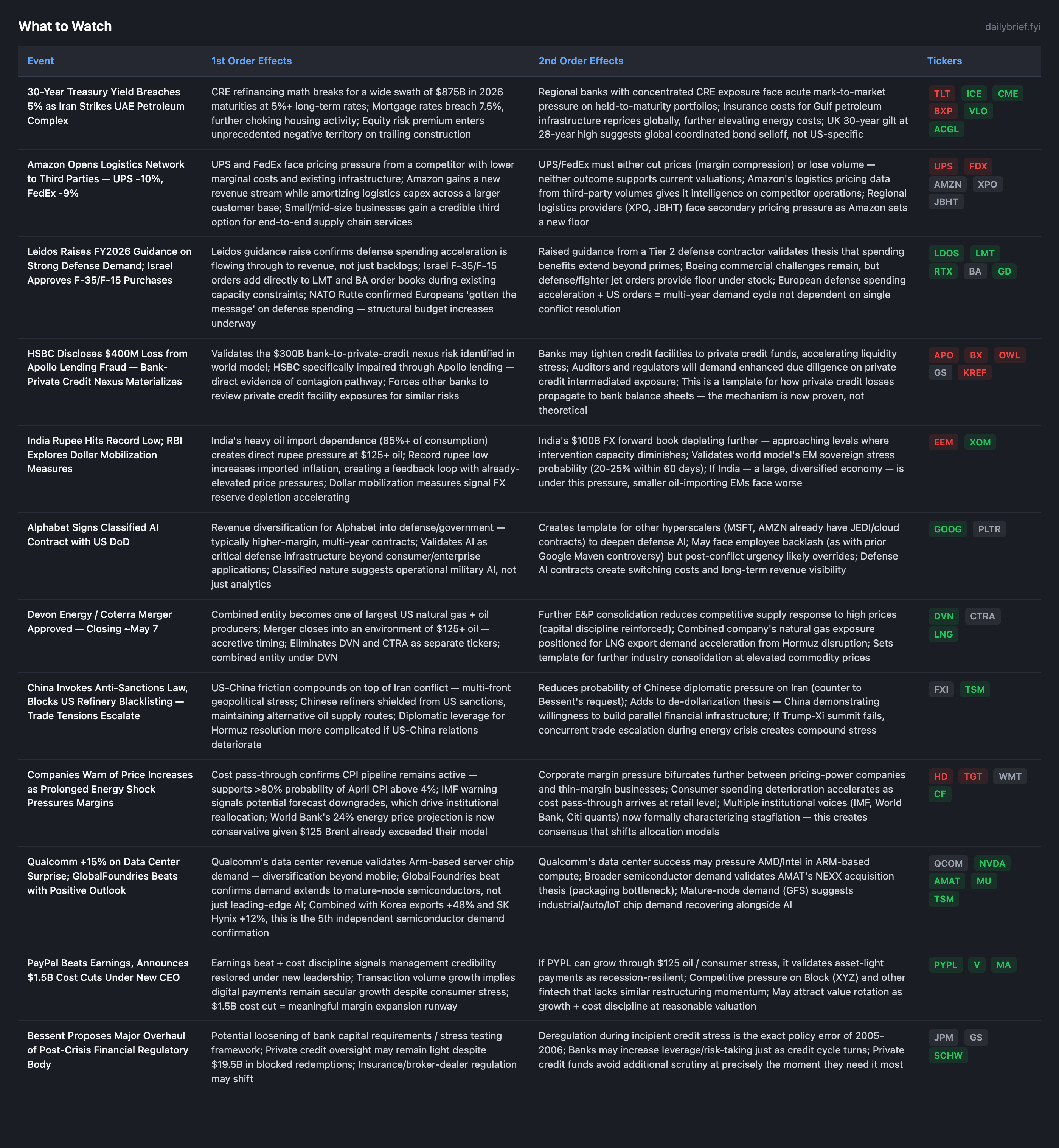
The options market is sending a critical divergence signal this week: HYG’s put/call open interest ratio sits at 5.27 (all-time bearish institutional positioning) while near-term implied vol remains just 5.4% — credit is coiled for repricing but hasn’t moved yet. Meanwhile, the 3-month SPY tenor at 14.3% captures the June 16-17 Warsh FOMC at what appears to be a modest premium given Kashkari’s explicit confirmation that forward guidance is suspended. BDC NAV marks due May 5-11, arriving in the wake of HSBC’s proven contagion mechanism, represent the immediate catalyst that could trigger the credit cascade at 55-65% probability within three weeks. Full options positioning analysis, portfolio playbook, and risk scenario framework below for subscribers.
This publication is for informational and educational purposes only and does not constitute financial, investment, or trading advice. The analysis, opinions, and commentary presented here should not be interpreted as a recommendation to buy, sell, or hold any security. Always conduct your own research and consult a qualified financial advisor before making investment decisions. Past performance does not guarantee future results.
